Alchemist of Found Materials and Forgotten Histories
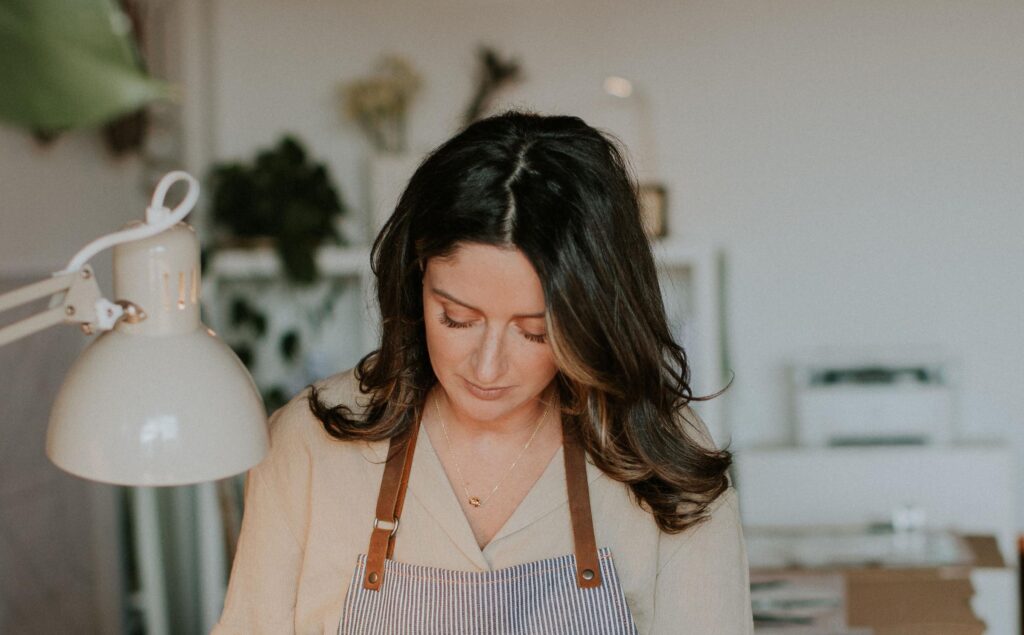
Toronto has long been a city alive with creativity, its artists weaving stories that reflect both its vibrancy and its shadows. Among them is Monique Vettraino, a west-end native whose practice in mixed-media analog collage is as haunting as it is enchanting. Her work embraces the gothic and the otherworldly while remaining deeply grounded in personal history and the Canadian landscape she reveres.
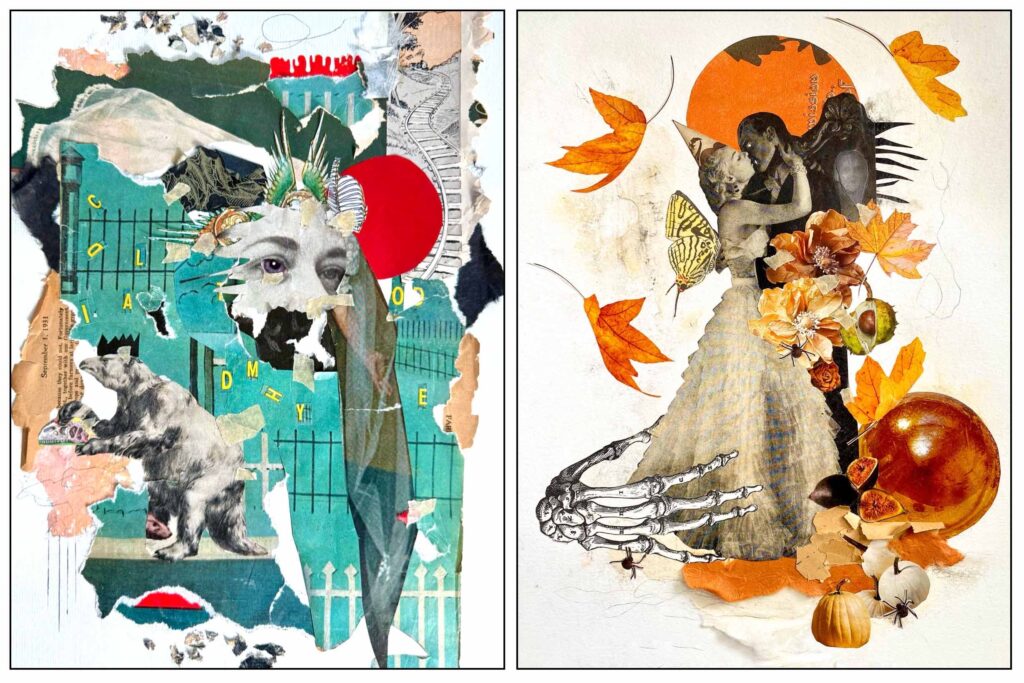
Monique’s collages are tactile, layered, and lived-in, each piece weathered with rips, transfers, smudges, and fragile fragments of old paper. They hold echoes of ancestry, women’s narratives, and childhood memories infused with magic, folklore, and resilience. For her, collage is not simply an art form but an alchemical act, where scraps of the past are reassembled into something protective, mysterious, and new.
With influences ranging from glassblowing in Murano to Toronto’s goth music scene, her work pulses with both chaos and harmony, vulnerability and strength. In conversation, Monique shares her journey, her process, and the ghosts both literal and metaphorical that shape her singular vision.
Could you begin by telling us a little about yourself. Where you’re from, your background, and what brought you to Toronto?
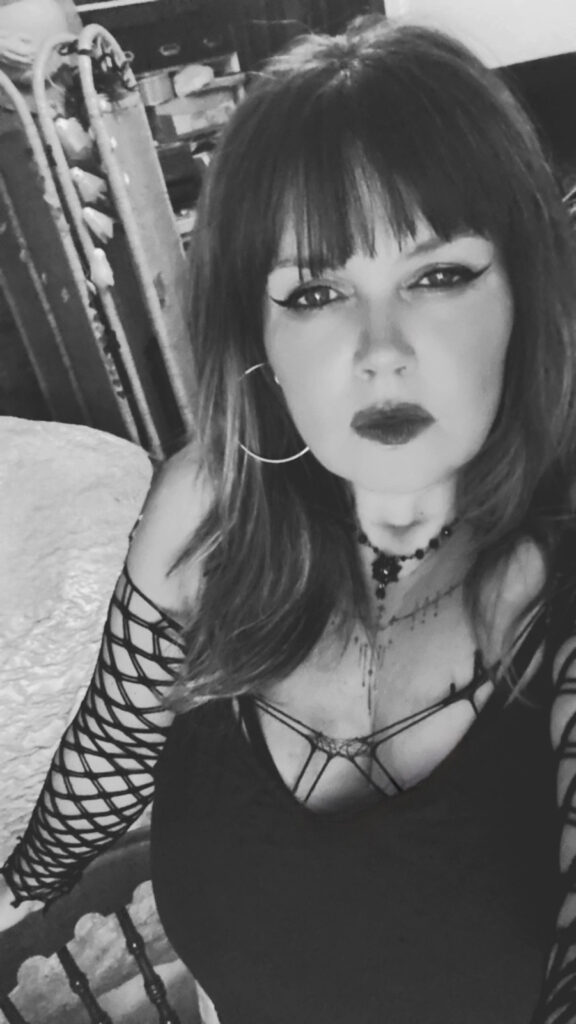
Hi, I’m Monique Vettraino, born, raised, and forever a west-end resident of Toronto. I am a mixed-media collage artist consumed by an undying macabre affection for all things deeply, darkly gothic, possess an undeniable pull towards that which is otherworldly, and carry a deep love of the majesty that is the Canadian landscape.
How did you first discover collage as your preferred medium, and what drew you into analog over digital methods?
I have been an art maker and creative seeker since childhood, although I struggled with finding an art form that resonated with me, paired with an unfortunate batch of unencouraging art teachers throughout my life. Being an artist and putting your work on display is such a vulnerable experience. Having a comfortable environment to create was crucial for me, and I just never found that.
It wasn’t until I took a course called Collage Explorations at the Toronto School of Art in 2019 that my path forward was illuminated. Having a gifted, encouraging, non-judgmental teacher who had numerous suggestions at the ready was life-changing. She brought to us numerous examples of collage in all its forms, historic to current, along with a variety of documentaries to ensure that we all found something that resonated. My brain was on fire with possibilities! This course continues to be available at TSA, led by Donnely Smallwood. I can’t recommend it enough, no experience necessary!
Analog over digital, sadly, is largely necessity as opposed to choice. I am a massive fan of digital collage, but my brain just doesn’t work that way. On the whole, I would have to choose analog for myself because I’ve come to learn that I need contact. I need to rip and scrape with gluey fingers and make marks that I can feel. It’s a sensory experience: the smell of an old book, the fragile nature of weathered paper from the turn of the century, the intensity of pressure I give the marks floating or hard.
I went through a few years as an early teen where I didn’t wear shoes, whether it was on concrete or grass. I have some inherent notion that if I can feel it, then it’s authentic and genuine, and I think that’s what analog means to me.
Can you walk us through your educational and artistic journey, formal training, mentors, or formative influences?
I’ve had two main streams of interest throughout my life: working with children and artistic ventures of endless variety. Consequently, I pursued two avenues in college, Early Childhood Education and Glassblowing, not simultaneously. Working with children has been a place of joy. Artistically, it’s a way for me to stay connected to that childlike sense of wonder, to retain a sense of innocence, and indulge in the dreamscape of magical thinking.
My artistic journey has not been linear, as I’ve previously outlined. It’s been a fitful kind of exercise trying to find a medium that felt like a match. With glassblowing, there were and are so many elements that I love it’s extremely magical. It just wasn’t a perfect fit. It was a chaotic environment (not my collage table kind), the materials are very expensive, and you can’t practise at home; you need a studio (not great for introverts). You can’t use your hands, it’s incredibly hot, and rather dangerous (my studio partner’s pant leg actually caught fire). All that being said, I think about taking classes again.
Last summer I travelled to Murano, Italy, the birthplace of glass, and it was so emotional. I am half-Italian, and it’s my ghost side, a silent, unknown passenger. Something was whispering to me on that tiny island and it hasn’t left. There is a story there: identity, glass, and all the lost things. I just have to figure out how to harness it.
You describe yourself as a “mixed media analog collage” artist. Can you unpack what that means in your creative process?
Analog is made with your hands and mixed media, in this case, is the addition of any medium outside of paper. I have used pencil, graphite, charcoal, pastel, paint, thread, fabric, ink stamps, bits of nature like leaves or bark. I would love to incorporate glass somehow! I have a bohemian spirit. It frightens me to be locked into any one particular style. Mixed media, to me, means free creative license.
What materials and tools do you most frequently turn to in your work, and how do they contribute to your signature style?
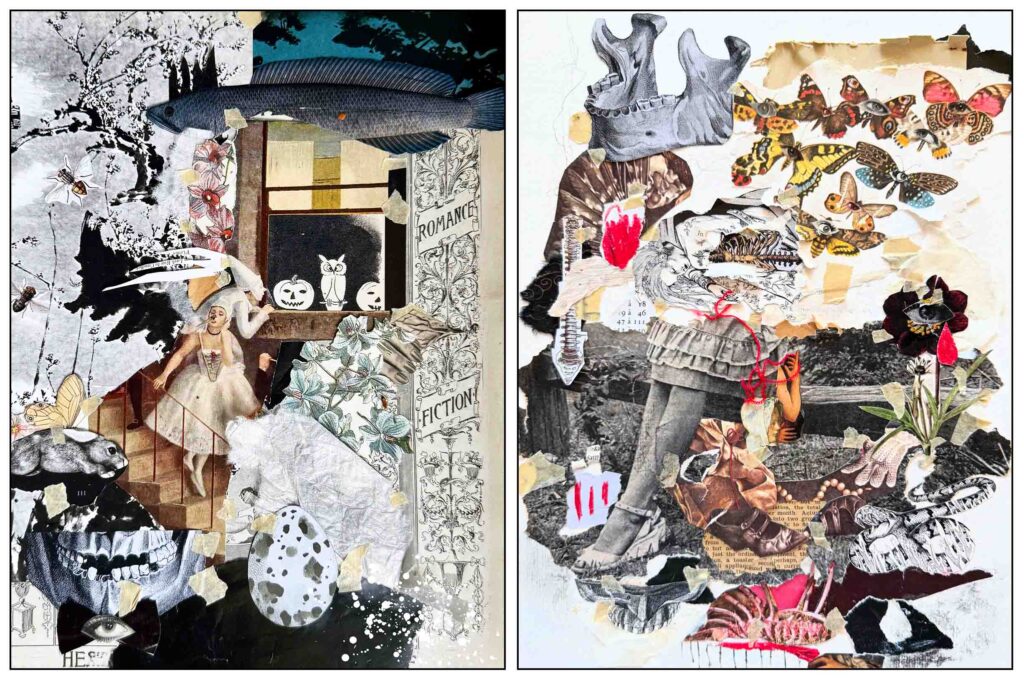
What has emerged as being a focal point in my work is a weathering, an aged look and feel. I achieve this through image transfers, graphite smudging, rips and tears, bits of masking tape holding pieces together, decollage which means to unstick by means of removing layers, removal of ink and pigment with water and paintbrush, and just a continual experimentation with this notion. I want my work to appear as though it’s lived a life, it has history and scars.
Many of your pieces are described as autobiographical and explore ancestry through a female lens. How does personal history and identity shape your work?
I grew up surrounded by women. I had very little male presence in my life. I was shaped by women with rich historical narratives of survival, stories of war and poverty, my own mum being a single mum of three and the inherent struggle that accompanied such responsibility, financial burden, disparity, and the enduring challenge of generational trauma. I learned that women help women and this is where I witnessed strength, perseverance, and a certain kind of beauty that found its way into the cracks. All the women in my life believe in magic and perhaps when life is so challenging it’s of necessity. I grew up with stories of elves in the trees and fairies in the forest and maybe I still believe. My nana read tea leaves, my mom read a beautiful deck of cards from the 1900’s, my eccentric English auntie is the resident Hallowe’en witch- her cackle is legendary, there were psychic friends, ghost stories, healing hands when life was painful, sweet grass, protective rocks, energy and white light. It was a both a magical and protective environment that presented proof, time, and again, that there are mystical, elusive elements that life is enhanced and nurtured by when lived in a cloak of mystery. I was raised to believe in magic and I do, I really do. I look at my work now and can so clearly see this sort of alchemy of this heritage that has shaped me. It’s as though the collages themselves are potions, ingredients sourced from a variety of places and timelines to culminate into their own being.
Your work is said to blend themes like escapism, the otherworldly, and magic. How do these elements manifest visually in your pieces?
Just seeing these 3 words brings gives me a surge of happy. How do they manifest visually? Hmm, well, it’s hard for me to be literal about what I intuitively use to represent this but I will try. Escapism, I almost always include some sort of flying element, birds, butterflies, insects, and the like. Oftentimes the characters themselves have wings. It is my intention to represent some sort of underlying darkness but to always offer a way out. The otherworldly and magic is a feeling I look to represent through floating figures, watchful eyes, mismatched landscapes, both illustrations and photographic, ethereal bits of floaty paper, surrealist combinations of characters such as flying fish amidst a midnight masquerade, bones are often exposed. My intention is that there are hard things but within it all, an overlying sense of mystery and beauty.
In the piece titled The Amabie, you reference a Japanese mythical creature tied to healing during the pandemic. What inspired that, and how did you translate the theme into collage?
This was a call to artists by the @thesocialglueofsydney.
“The Amabie is a Japanese Yokai that can ward off epidemics. A mermaid-like creature with long hair, a beak, and 3 legs. If an epidemic occurs, draw a picture of me and show it to everyone”, said the Yokai.
A collagist’s dream! Collecting bits and pieces to form a mythical creature during a time that felt so out of control to bring focus back to something that felt relevant and good. I wanted her to appear as though she’d been blown in by the wind, much like the pandemic had been, unexpected, but in the best way, supplying oxygen through her sails to all those in need. (as an aside, her head was that of Anne Boleyn for added symbolic richness).
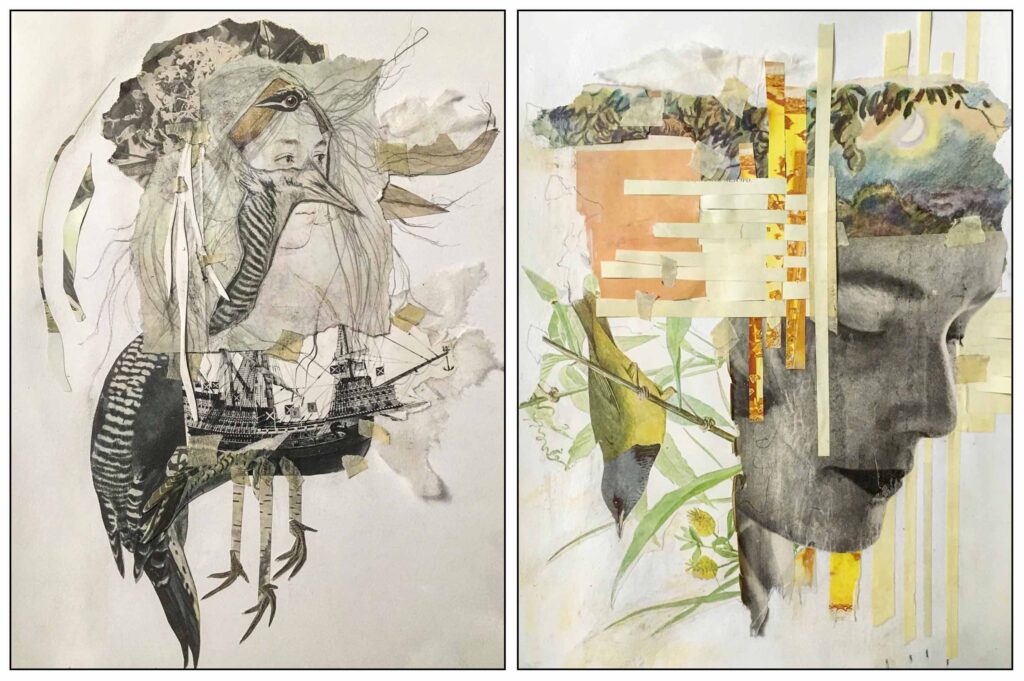
You were featured in the Glenhyrst Gallery exhibition To Piece Together, where your work was noted for visual poetry and powerful use of found materials. What did that recognition mean to you?
I was part of this show along with two amazing collage artists, Loraine Mohar and Jennifer Murphy. Lorraine had suggested my work to the gallery’s curator and I was and am so grateful for this honour. Thank-you, Lorraine! Seeing as this gallery is outside of Toronto (it’s in Brantford) I had never been and didn’t know anything about it. When I got there, I was given a guided tour complete with its history. Firstly, the building is so beautiful. It was constructed in 1922, reminiscent of the Edwardian style. The walls do talk and there most definitely must be ghosts!
Glenhyrst was built by a local farmer who became known as an expert in horticulture and an advocate of art and culture. He created gardens on his 15 acre plot that he believed were best shared with others and hung a sign that said “Visitors Welcome”. He invited everyone to tour his gardens as well as into his home to view his art collection. It was his wish to continue to share his love of art and gardening with others, and as such, it was donated to the City of Brantford.
It’s such a beautiful story. I can’t imagine a more perfect setting for my art, extensive gardens, gorgeous old architecture, and after dark spectral spectators!!!
When I went to pickup my work at the end of the show, I was told by a woman that worked there that it was their best received exhibit that she’d witnessed. She said that people were really excited with the content and she’d never had so much feedback. I mean, you can’t really wish for more than that as an artist.
How do you feel about your work being characterized as “durational and meditative” puzzle-like processes? Do you aim for that effect consciously?
Oh wow, I don’t recall reading this but it certainly makes me emotional. Durational and meditative. Durational means long lasting and meditative is to stop and pause. In our 2025 world where people are spinning with busy, attention span is diminished and we look to digest information in the most immediate way possible, I don’t think I could wish for anything more meaningful. I am so honoured when anyone takes the time to stop, look, and comment on my work. This touches me deeply. Do I aim for that consciously? I don’t think I could possibly, and in fact, I aim for so little consciously being the dreamer that I am. You can find me somewhere up in the clouds lost in thought.
The idea of building a collage artist community in Toronto was mentioned in Deep Cuts with Monique Vettraino. What progress have you made with that, and how do you envision it growing?
Breaking out of my safe-zone and into the world at large is still on my to do list. I have made no progress on this front but other Toronto collage artists have which is absolutely amazing! A Toronto artist named Daria Beer, @dbcreative_collage, has created @torontocollagecollective and is the organizer of collage meet-ups. I have only attended one so far but will absolutely make it out to more in the future. It’s wonderful to know that our community is finding one another and who knows what that may lead to. It’s very exciting.
Can you share what first inspired you to explore themes like “buried darkness” and “seeking light” in your art?
I am fascinated with what is hidden, secrets, all that we keep buried. The elements we keep locked in the dark, our vulnerability, it’s where our most authentic beauty lies. In my work I bring the scars, the rips in our seams to the exterior. I often bring a protector too, the all-seeing eye or some element of guardianship. Unearthing all the pieces of ourselves to rise to the surface, to let the light touch it and exist as the sum of all our parts is a powerful thematic force in my work.
Are there non-visual influences like music, literature, and mythology that shape your creative vision?
Music has influenced my life in every way possible and can’t help but make an appearance in my work. Postpunk, darkwave, goth, industrial are my foundation but I am a music lover of all sorts. (I’ll include Neil Young, the original Canadian badass, relentlessly taking on the establishment and , in fact, I just read he has a new anti-Trump song called Big Crime) Postpunk was my first love, a doorstep to rest my pensive gloom upon, that dark romanticism has always lived inside of me. There was so much searching but finally finding the goth scene in Toronto was such a galvanizing event, it was a missing piece of what is now most certainly part of my being. The music was and is my lifeline, the lace, leather and corsets, the community, so radically accepting, creative, anti-fascist and safe. I’d once described my work as being a cross between The Cocteau Twins and Skinny Puppy, ethereal mixed with raw dissonance and I guess that would accurately describe me as well, artist and art inextricably linked.
Literature and mythology, I am haunted house. I even have my own real life ghost stories to draw upon, haunted in every way. I adore all things dark and spooky, ghosts and goblins, witches, vampires, and the full moon. I feel most creative in this realm of the supernatural. Perhaps it’s tapping into that childlike love of Hallowe’en, a love that has grown into a literal monster of a display on the actual night! Pumpkins, falling leaves, spooky movies, my ultimate happy place. I try and live here in my head, a darkly romantic, mysterious landscape wrapped in a cloak of fog. This haunted wonderland is me and my art.
How do you choose what found materials to use? Is there symbolism behind using old books or photos?
So much symbolism. Old books have that smell that immediately transports you to an alternate universe. The stained, watermarked, coffee ringed, weathered paper, its fragile nature, the vintage inks, the transcriptions to loved ones in beautiful cursive writing, they’re haunting. The emotion woven into the hunt for imagery and feeling the stories of those that once were in your hands, the contemplation of how fleeting it is to be on this earth and the where have you gone, where will we go? Ghost stories. There’s a bit of that ache before a piece even begins.
What role does intuition play during your collaging process? Do ideas evolve organically in the studio?
My process is almost entirely intuitive. I usually look for a central piece that speaks to me and build around it. If I go in with a preconceived idea, I don’t think it’s ever turned out the way I envision it. It’s frustrating. It’s also very challenging as an analog artist to make a very specific vision come to life. This is where I wish I could use digital tools. Maybe one day!
In my last piece, I had a vision. It did not turn out the way I had imagined but I worked through this telling myself, it’s not what you had in mind but you might like it better. It worked! I really like it. I just don’t ever want to stagnate, it’s an artist’s worst nightmare, not the kind I like.
As your following grows, you’re now among the top analog collage influencers on Instagram. How do you balance visibility with artistic integrity?
There is a world of amazing collage artists that Instagram has introduced me to and I am so grateful for this. It’s inspiration and motivation to continue working. I’m a novice when it comes to social media. I joined Instagram to make this account in 2019. I have no idea how to win the algorithm, although this has become extremely frustrating for artists over the past few years. I feel so fortunate to have had exposure that has made my art available to a wider audience. With my tendency to cocoon myself, my work would most certainly never have seen the light of day. In the most simplistic terms, I just want people to see my art and feel a connection.
What’s your typical studio setup like, and how do you organize your space and materials?
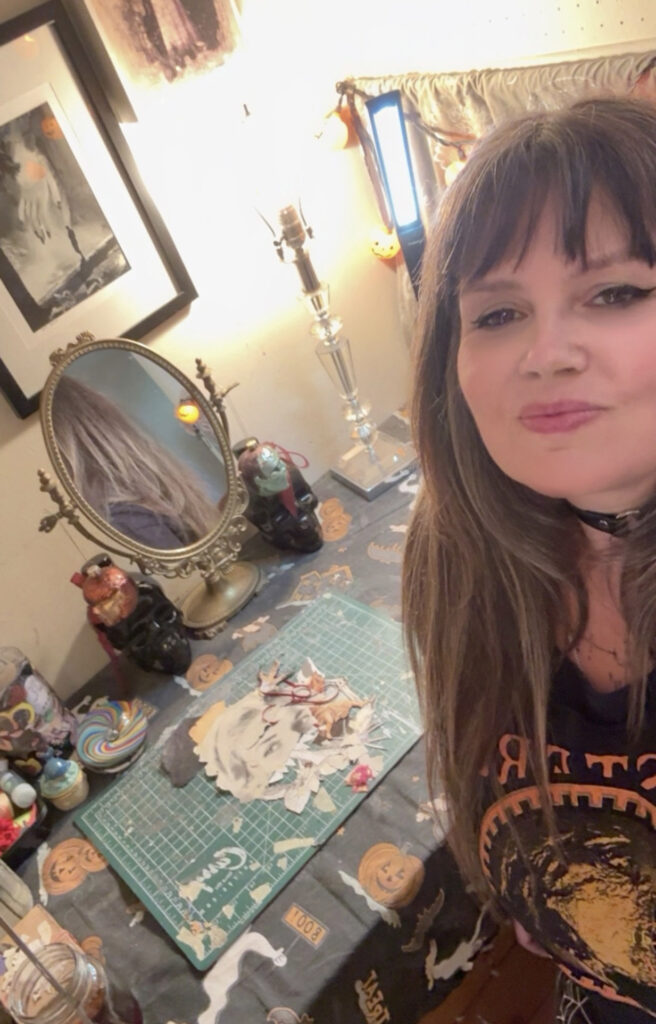
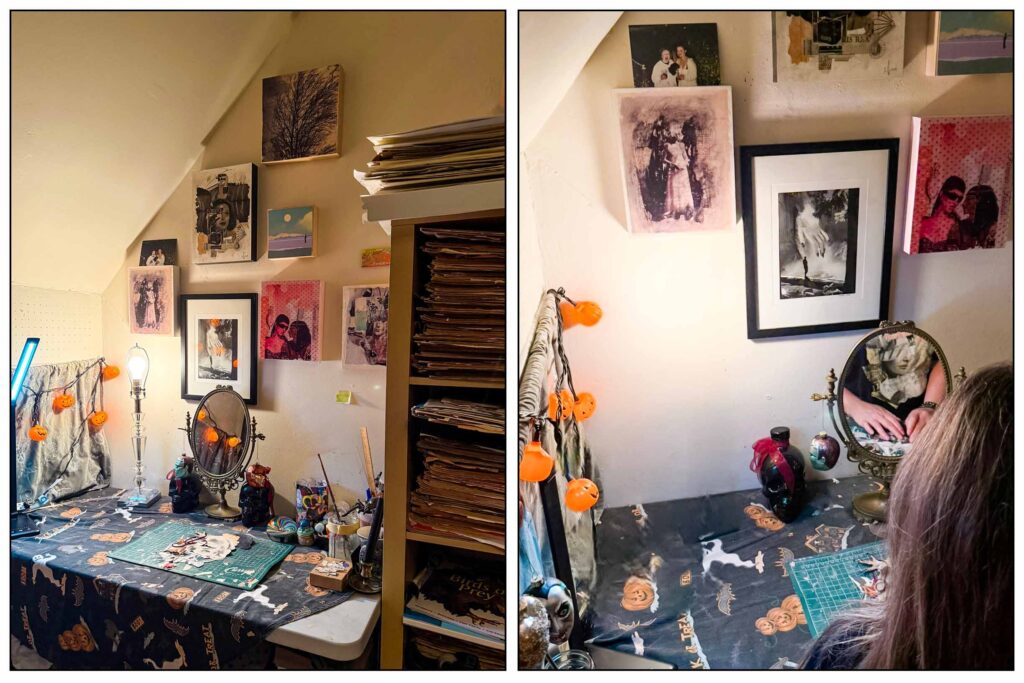
Ah man, really not my strong suit. I thrive on an element of chaos and I find having pieces all about helps me create. It’s like a cocoon of innumerable stories to be told. The downside here is that I work in a corner in my room, I love that it’s cozy but this art form does not lend itself to small spaces. I have a giant collection of magazines, books, paper, and then the mixed media elements. I have to try and find a balance between order and chaos in a small space that best lends itself to creative expression. It’s a challenge.
How long does an average piece take to complete from concept through final touches?
I have developed a bad habit of assembling a piece, holding it together with bits of masking tape and putting it off to the side to then start a new one. I hate gluing! This is where the anxiety seeps into analog collage. It’s is where things can go wrong, especially if you are particularly attached to certain imagery.
Composition is something that I find either quickly falls into place or is absolute hell requiring endless repositioning. The composition and colour combination is important to me and can be difficult. I try not to walk away from a piece in fear I won’t return to it, an exercise in being completely honest with myself and certain unhelpful tendencies. It will take me anywhere from 2 to 8 hours to assemble the composition and another 2 to 4 hours to glue things down and add the mixed-media elements.
What kinds of stories or emotions do you hope viewers take away from your work?
That’s a tough question. I’m so nervous about influencing the viewer in any way that I’m often hesitant to attach a title to my work. The collages are fragments of my core stories and how I process the world around me. My hope is that when my work is viewed that there is some sort of mirror for the viewer, that you can see you too through your own unique lens.
Do you offer workshops, classes, or newsletters to bring others into your process?
In an attempt to stay in the shadows, I don’t! Although, on occasion, I have been asked if I offer workshops. It’s something I continue to contemplate and hope to carry into the light of day at some point, although being a vampire does really appeal to me. Maybe I can offer an after dark workshop accompanied by red wine (non-alcoholic also on hand of course), some gothic harpsichord-type classical music, a blaze of candlelight and hmm, I suppose I need a gothic castle. Now I am truly in my element!
My thought is to develop a workshop to combat artistic anxiety which I think, in many ways, “Collage Explorations” was. I would not be a practicing artist, nor would I have found my medium without it. Feeling the safety to explore without making “mistakes” has helped me develop my style. If something doesn’t work, it becomes part of the story. If the glueing is not perfect, I rip it and reglue it. If there is an unintentional mark, I decide whether or not I want it there, make it more bold or cover it up. This kind of flexibility is what I need and I know that it’s what many non-practicing artists need too.
Outside of art, what are your favorite hobbies or ways to recharge creatively?
I oscillate between chaos and silence, it’s a pattern I’m becoming more aware of in my art and, indeed, all areas of my life. Perhaps that’s how I find some sort of equilibrium.
Music, concerts, dancing at our goth spots is a lifeline. It’s a physical release, a purging of emotion, therapy. And on the flipside of this is to be fully immersed in nature. I feel incredibly fortunate to be located so close to the rugged beauty that Ontario has to offer outside of the city. As children, we spent summers largely at a cottage by the lake that was most generously offered to us by family friends. Time there included swimming, canoeing, fishing, toad catching, rock collecting, leaf pressing, wild flower and berry picking, along with perusing antique shops. We would take trips to local garbage dumps after dark to look for bears and drive to Algonquin Park in search of moose, beavers, any and all the wildlife! The night belonged to the dazzling gleam of the starry night that a city kid wouldn’t even know exists. Such beauty was a springboard for my creativity-it was and is a place to dream and revisit. My ultimate fantasy is to have a studio that’s immersed in the beauty of this, my beloved northern Ontario landscape.
Finally, your message for us at TorontoPages magazine.
I want to thank you for your well-researched, sensitive, and thoughtful questions. It means so much to me. It’s been a pleasure to try and do them justice. Our city is exploding with talent.