Inside Malcolm D. Roberts’s The Quote Effect, where famous words become practical lessons for modern cyber defense.
A familiar sentence. A new security lesson.
Cybersecurity is full of frameworks, controls, acronyms and plans. Malcolm D. Roberts starts somewhere far less intimidating: with words people already know. The Quote Effect: Old Wisdom, Modern Threats takes ten familiar quotations from athletes, presidents, inventors, writers and entertainers and uses each one as a doorway into a modern cybersecurity discipline. Mike Tyson becomes a lesson in incident response. Dwight D. Eisenhower opens a discussion of business continuity and disaster recovery. Ronald Reagan’s ‘Trust, but verify’ becomes a way to think about identity and access. Maya Angelou’s call to do better once we know better becomes a framework for continuous improvement.
That is the book’s central trick, but it is more than a gimmick. Roberts is trying to solve a real communication problem. Security teams may understand the vocabulary of risk, governance, resilience and incident handling, but the people who make decisions about those things do not always speak the same language. A memorable quote gives the reader a handle. The story behind the quote gives it context. The cybersecurity lesson makes it actionable.
The result is deliberately not written as a technical manual. Roberts wants the book to work for practitioners who need better ways to explain security, and for leaders, managers and everyday users who want to understand why security decisions matter without first memorizing an alphabet soup of standards. His goal is practical: make the idea clear enough that a reader remembers it when the pressure is real.
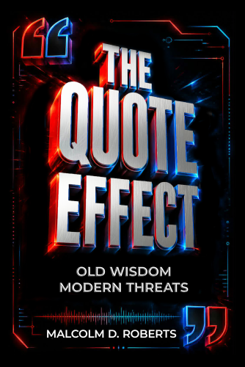
A good quote sticks in the mind. The cyber lesson sticks because the quote got there first.
WHAT THE BOOK SEEKS TO DO
| Across the book, the pattern repeats. Each chapter starts with a recognizable line, looks at the life and circumstances that gave the line meaning, then brings that lesson into cybersecurity through cases, operations and firsthand experience. The thesis underneath it all is simple: cybersecurity is a human discipline as much as a technical one. Plans, tools and policies matter, but people still have to decide, adapt, communicate and recover when reality refuses to follow the script. | That makes Mike Tyson an unexpectedly perfect opening act. His famous observation about plans surviving only until the first punch is funny because it is blunt, and useful because almost anyone who has managed a crisis has lived some version of it. The chapter turns that one sentence into a discussion of what incident response really demands: preparation before the crisis, clarity during the chaos, and the ability to adapt after the first assumption fails. |
BOOK EXCERPT
CHAPTER 1: MIKE TYSON
“Everyone has a plan until they get punched in the mouth.”
The quote remains powerful because it reaches beyond boxing. Tyson’s life proves that plans matter, but pressure reveals the truth. His opponents had plans, and Tyson had plans too. Some worked; some collapsed under bad decisions, grief, ego, temptation, or a better fighter across the ring. The punch in the mouth is not always literal. Sometimes it is poverty, fame, loss, scandal, or the death of the person who kept you grounded.
At his best, Tyson turned fear into focus. He moved toward what scared him and became one of boxing’s most feared champions. But his life also became a warning that talent without stability can turn into a storm with no steering wheel. His story teaches that a plan is only the beginning. What matters is what happens after the plan gets tested.
That is why the quote survives. It is blunt, even funny, but it is true. In cyber terms, Tyson’s career reads like a lesson in incident response: read the situation, recognize change, recover from pressure, and adapt fast. Success is not measured by whether the plan survives untouched. It is measured by what you do after the punch lands.
When the Plan Gets Punched: Colonial Pipeline and Incident Response
A real-world example of Tyson’s quote in action came in May 2021, when Colonial Pipeline was hit by a ransomware attack. On paper, organizations have incident response, continuity, recovery, and communications plans. Then ransomware hits. Systems go down, operations stall, leaders want answers, customers panic, and the media watches. In an instant, the calm conference-room plan has been punched in the mouth.

“The punch in the mouth isn’t always literal.”
Colonial Pipeline ran one of the most important fuel pipeline systems in the United States. When ransomware hit its business systems, the company shut down operations as a precaution. Fuel delivery affects transportation, airlines, emergency services, businesses, and everyday commuters, so the incident quickly became more than a technical problem.
That is where Tyson’s quote becomes more than a clever line. Before the attack, the organization likely had a plan. Once the event began, that plan had to survive pressure, uncertainty, and incomplete information. Nobody knew immediately how bad the damage was, how far the attacker had moved, or which decisions might create new risk.
That is the heart of incident response. It is not the fantasy that nothing bad will ever happen; it is the discipline of responding well when something bad is already happening. A strong program helps an organization detect the event, understand it, contain the damage, remove the threat, recover operations, and learn from the experience. But every step gets harder once the punch lands.
In the Colonial Pipeline case, leaders had to make hard decisions fast: whether operations could continue safely, how to coordinate with federal agencies and law enforcement, and how to communicate while restoring systems. That is not just cybersecurity. That is crisis leadership under pressure.
The incident also showed why incident response cannot live only inside the IT department. A cyber event can become a business, legal, communications, supply chain, and public-trust problem all at once. The technical team fights the malware, but leadership still has to decide how the organization keeps operating.
That is why a plan alone is never enough. A plan nobody has practiced is just a theory. A contact list nobody has updated is a liability with phone numbers attached. Incident response needs preparation, exercises, technical testing, decision-making authority, and clear communication long before the crisis begins.
A plan nobody has practiced is just a theory. A contact list nobody has updated is a liability with phone numbers attached.
Tyson’s point is not that plans are useless. He trained, studied opponents, and had strategy. His point is that the first real hit changes the fight. Incident response works the same way. The goal is not to build a perfect plan, but to build a team that can think clearly once the plan has to change.
A ransomware attack is a punch in the mouth. So is a data breach, a compromised administrator account, or a major outage during peak operations. What matters is how the organization responds after impact: how quickly it detects, contains, communicates, recovers, and improves.
Colonial Pipeline became a national reminder that cyber incidents do not stay neatly inside cybersecurity. They spill into operations, the economy, and public trust. Mature organizations are the ones that have trained, practiced, and prepared enough to keep fighting smart after the punch lands.
The mature organizations are the ones that have trained enough, practiced enough and prepared enough to keep fighting smart after the punch lands.
THE MAN BEHIND THE EFFECT
A career built where security plans have to survive contact with the mission.
Malcolm D. Roberts
The voice behind The Quote Effect comes from a career spent close to that collision between plans and reality. Malcolm D. Roberts is a cybersecurity professional, U.S. Army veteran and defense contractor with more than 30 years of experience protecting mission-critical systems for the U.S. military and federal government. His work has taken him across the United States, Kuwait and Afghanistan and into environments where technology, national security and mission success are inseparable.
Roberts served in the U.S. Army from 1996 to 2003, then built a cybersecurity career around Risk Management Framework work, Information System Security Officer operations, vulnerability management, continuous monitoring, incident response, enterprise compliance and cyber risk management. His professional certifications include CISM, GCIH, CompTIA SecurityX, Microsoft Azure Administrator Associate, CCNA, Security+ and Network+.
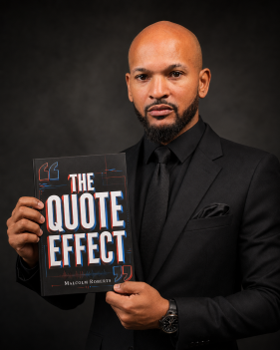
U.S. Army Veteran • Cybersecurity professional • Defense contractor • Author
But the credentials are not the point of the book. The point is translation. Roberts argues that cybersecurity ideas become more useful when people can connect them to something human: a boxer absorbing pressure, a general preparing for uncertainty, an artist learning from failure, an inventor refusing to stop after setbacks. The familiar quote becomes the memory hook; the cyber lesson becomes the thing the reader carries back to work.
“Make cybersecurity practical, accessible and meaningful.”
WHY IT LANDS
| That is also what gives The Quote Effect its broader appeal. A reader can come for the personalities and stories and leave with a clearer way to think about incident response, resilience, risk, identity, governance and improvement. A seasoned security professional can come for the cyber lessons and leave with better language for explaining them. Roberts’ first published book is ultimately an argument that old wisdom still has operational value – especially when modern threats arrive without reading the plan first. | The book’s promise is modest but useful: if one quote helps a reader ask a better question during an incident, explain risk more clearly, challenge blind trust or prepare more seriously before a disruption, the lesson has done its job. Roberts is not trying to make cybersecurity mysterious. He is trying to make it memorable – because what people can remember under pressure is far more valuable than what they once skimmed in a binder. |
***The excerpt and this article were written and reproduced with full permission from author Malcolm D. Roberts.