Painting Memory, Identity & the Spaces Between
In a world where identity is increasingly shaped by movement, memory, and belonging, artist Emmette Lewis creates work that quietly invites audiences to pause and reflect. Through deeply personal visual narratives, Lewis explores themes of diaspora, family, ecology, grief, and cultural memory, transforming intimate experiences into emotionally resonant works that feel both personal and universal.
Raised between South Africa and British Columbia and now based in Toronto, Lewis draws from the intersections of geography, heritage, and lived experience to create pieces that blur the boundaries between documentation and emotion. Working across painting and archival materials, her practice examines how home, identity, and place continue to evolve across time and distance.
In this exclusive interview with TorontoPages Magazine, Emmette Lewis reflects on her artistic journey, creative process, evolving practice, and the powerful role art plays in preserving connection, reclaiming identity, and telling stories that transcend borders.
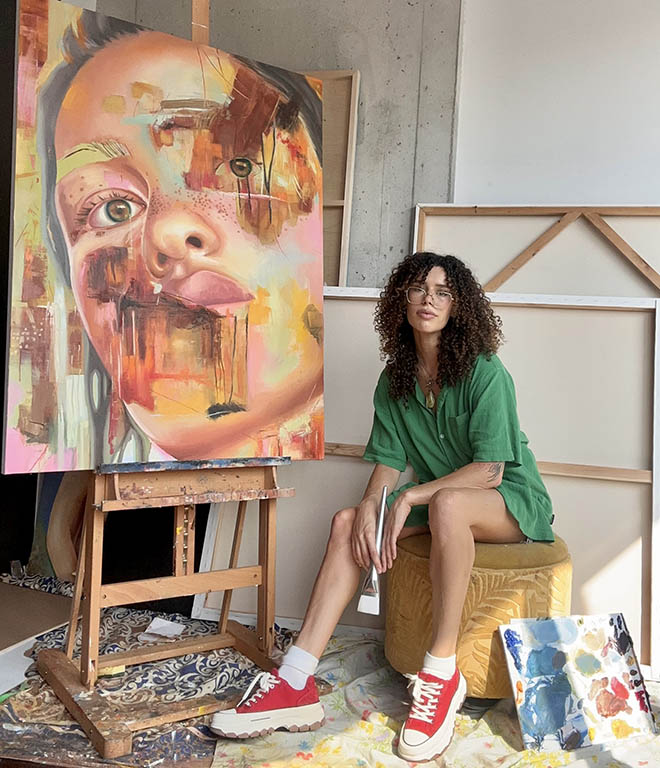
To begin, can you tell us about your upbringing between South Africa and British Columbia, and how those environments shaped your identity as an artist
Growing up between South Africa and British Columbia definitely shaped the way I understand identity and belonging, and those influences have become central to my art. My parents immigrated from South Africa to B.C., but we would return often to visit the family who remained there. However, I always felt that distance profoundly in the way I carried myself.
My work is deeply rooted in community, family, and cultural memory, so now, living in Toronto, my art has become a way of holding those formative experiences of South Africa and British Columbia close to me. I also use my art to discuss my personal experience of diaspora between these two environments and how absence, dislocation, and cultural grief can obscure and reshape identity.
Painting allows me to reconnect with the parts of myself that feel obscured while also celebrating home, even while being geographically separated from family.
What first drew you to visual art, and when did you realize it could become a serious career path?
For me, I never initially approached being an artist with the intention of it becoming a serious career path. When I first started creating, it came purely from a place of creative passion and personal necessity. Art was essential for self-fulfilment, helping me better understand my identity and fill the parts of myself that felt absent.
It was also something that surrounded me while growing up. I’d make art with my aunt and father, and it was always about creative connection and shared expression rather than the final outcome.
When I first arrived in Toronto, I didn’t fully see being an artist as something tangible because so much of my work comes from such a personal place. Even now, I still feel like I’m continuously navigating this career as an emerging artist. I also believe that going into art purely with the intention of achieving recognition or success can limit the work itself. For me, meaningful art has to come from genuine intention and authenticity, whatever that voice looks like for someone. The most important part of my practice is staying connected to the reasons I started creating in the first place because I think art thrives when it is honest.
You studied at Emily Carr University of Art + Design and later completed your BFA at York University. How did those two educational experiences differ in shaping your practice?
My experiences at Emily Carr University of Art + Design and York University shaped my practice in very different ways
When I attended Emily Carr, I participated in their summer program. I was very young, around sixteen, and I was suddenly immersed in this entirely new creative world in Vancouver. At the time, the artists, mentors, and students there felt larger than life to me. I remember being deeply inspired simply by being in that environment.
It opened my eyes to the possibility of what an artistic community could look like. There was something expansive and exciting about that experience, especially at an age when everything feels so illustrious.
When I entered my BFA at York, my relationship with art became more complex. At times, I struggled with the feeling that art needed to fit within institutional frameworks, and I found myself questioning where authenticity exists within those systems.
However, that tension actually became an important part of my growth as an artist because it pushed me to redefine how my art could resist categorization and limitations.
Looking back now, I see how much my work transformed throughout that period. The experimentation, uncertainty, and even the failures became valuable lessons. They pushed me to think more critically about how I want my work to exist in the world and how I want audiences to experience it emotionally.
Now pursuing your MFA at OCAD University, how has your current research or studio work evolved compared to your undergraduate years?
Pursuing my MFA at OCAD University has completely shifted the way I approach my practice.
During my BFA, I think I was very critical of my work and overly aware of what I thought the contemporary market wanted from me. Even though my work came from a personal place, I was still keeping it very editorial and safe. I was hesitant to fully centre myself and my own experiences within the work and to really push the boundaries of what I believed I could do.
Now, I’ve thrown all of that out the window.
I’m much more focused on making the work I genuinely feel compelled to create for myself rather than trying to fit into an identifiable box. My work now feels unburdened by those voices. It revolves entirely around photographs of my family, my community, and the people who inspire me, and it feels much more grounded because of that.
Your work reflects both South African artistic traditions and the ecology of British Columbia. How do you consciously merge these influences in your visual language?
Throughout my life, these two worlds have always been intertwined, so it feels very organic in my practice. The amalgamation of both South Africa and British Columbia has never been something I had to force to coexist because I have always been living between both spaces, and that in-between is exactly where I find my influence.
In B.C., my parents did a great job of keeping our traditions alive through music, food, and language. The gaps that came from missing one home while being in another are actually what I try to trace in my art; they inform my understanding of these influences. Additionally, I actively resist cultural essentialism in my work. I don’t want my art to become a surface-level or “tourist” representation of either place. When I draw from these influences, I’m working from real-life experiences and real people. In that way, I’m not just presenting culture or tradition as an idealized version, but showing how it is actually lived day to day and held on an individual level.
Early in your career, you explored expressionist portraiture and figurative abstraction. What prompted your shift toward environmental commentary and eco-conscious themes?
Working with themes around ecological preservation and environmental consciousness came partly from my time in British Columbia and partly from South African art. One of the main things I’ve come to understand is that the environment you grow up in, and the land you work on, are inseparable from who you are, especially through the resources and influences you have access to. The environment shapes who we are, and in turn, how we shape it feeds back into who we become.
A lot of art in South Africa is created using recycled materials such as metal, plastic, and organic and synthetic objects. This prompted me to look introspectively at how I work with my materials and the responsibility I have for what I produce. Working with environmentally conscious materials such as recycled fabrics and discarded textiles became a way to engage intentionally with the subject matter I was pursuing while also reflecting the realities of consumption, waste, and the environments I respond to in my work.
How would you describe your current artistic style to someone encountering your work for the first time?
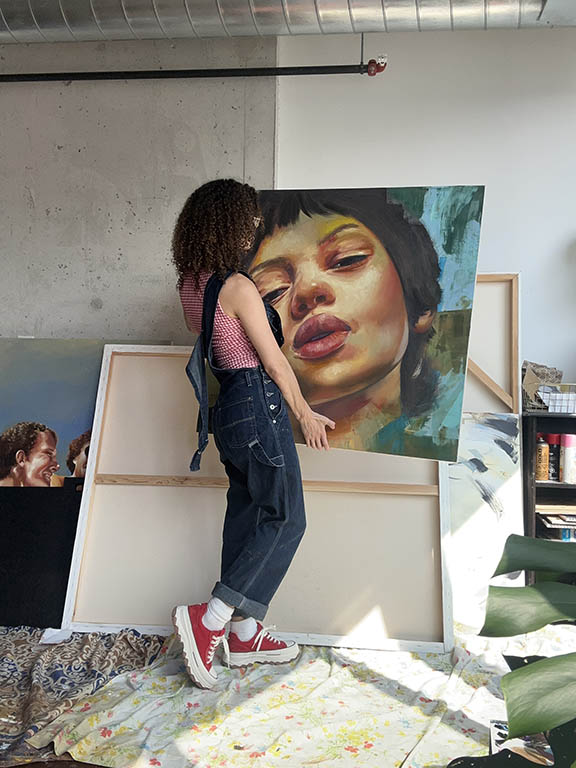
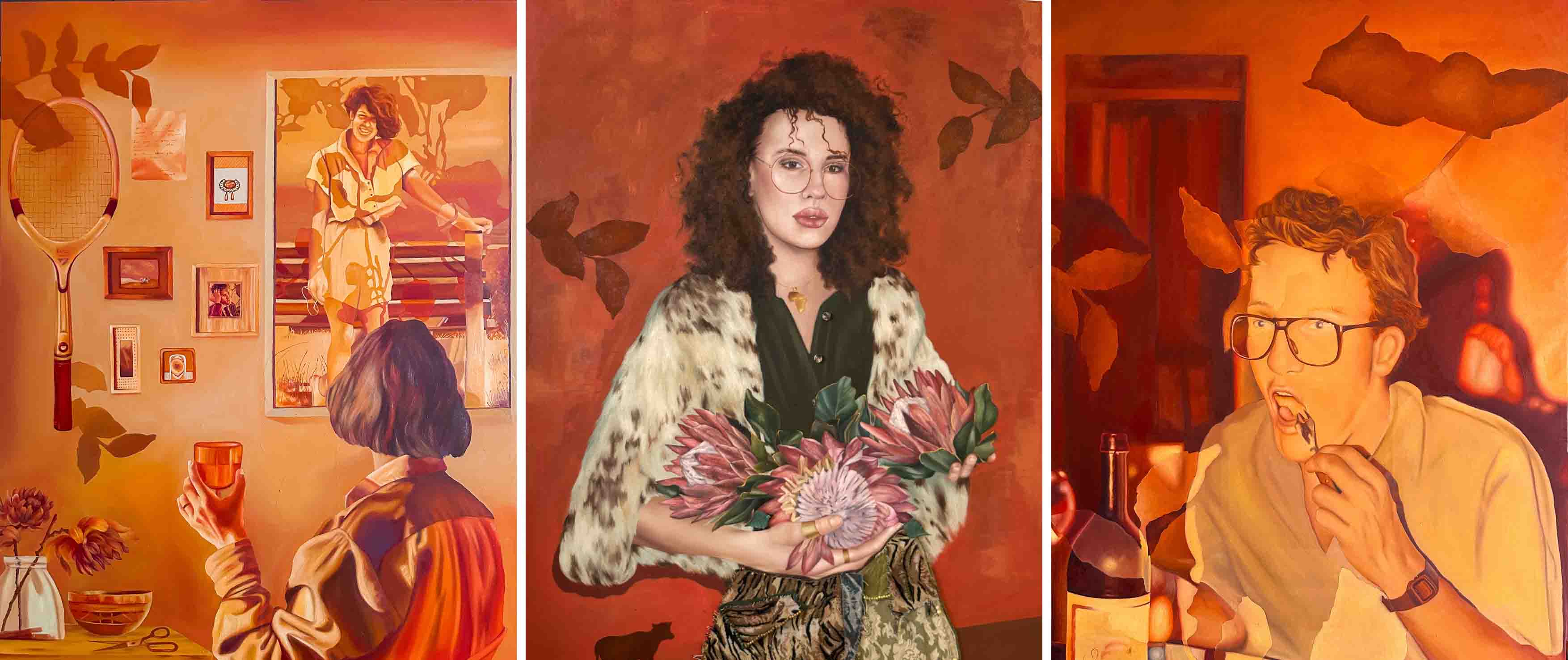
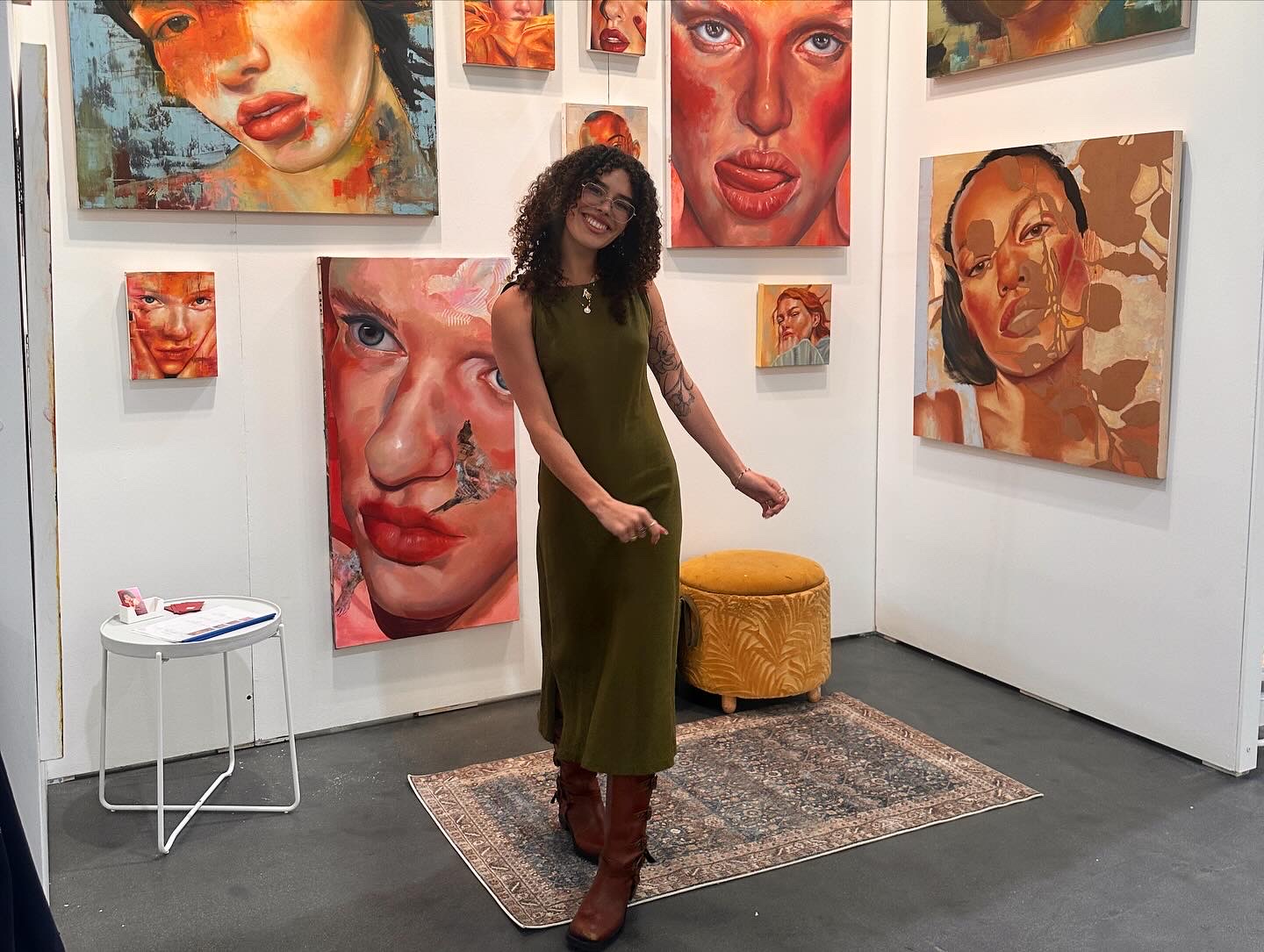
My current practice is centred on exploring my personal experience of diaspora and identity. I use family photographs, both past and present, to think through grief, celebration, and reconnection to self. The objective of my work is for the audience to feel as though they are walking into a memory. The colour palette is specifically inspired by feelings of familial warmth and that sense of comfort you get when arriving home after being away for a while. Even if the viewer doesn’t recognize the setting or the people, I try to work with the emotional weight of familiarity and belonging, transforming loss into reclamation.
Nature and ecology seem central to your recent work. What specific environmental concerns are you responding to right now?
Right now, the environmental concerns I’m responding to are less about one specific issue and more about how land, ecology, memory, and identity are interconnected.
In my work, I’m thinking about how diaspora changes and challenges your relationship to place, and how your environment, home and land becomes something you carry rather than something you simply live on. Through materials such as stamps, textiles, banknotes, and state documentation, I challenge how borders define and limit identity.
In this sense, I’m currently exploring how systems of classification and bureaucracy shape who we are understood to be, and how those imposed structures can feel both physically and psychologically defining. My discussion of land here is really a discussion of ownership and ecology. In my work, I resist the idea that belonging should be limited by where we are classified through borders, and how state boundaries determine how identity is recognized and understood.
Can you walk us through your creative process, from initial concept to finished piece?
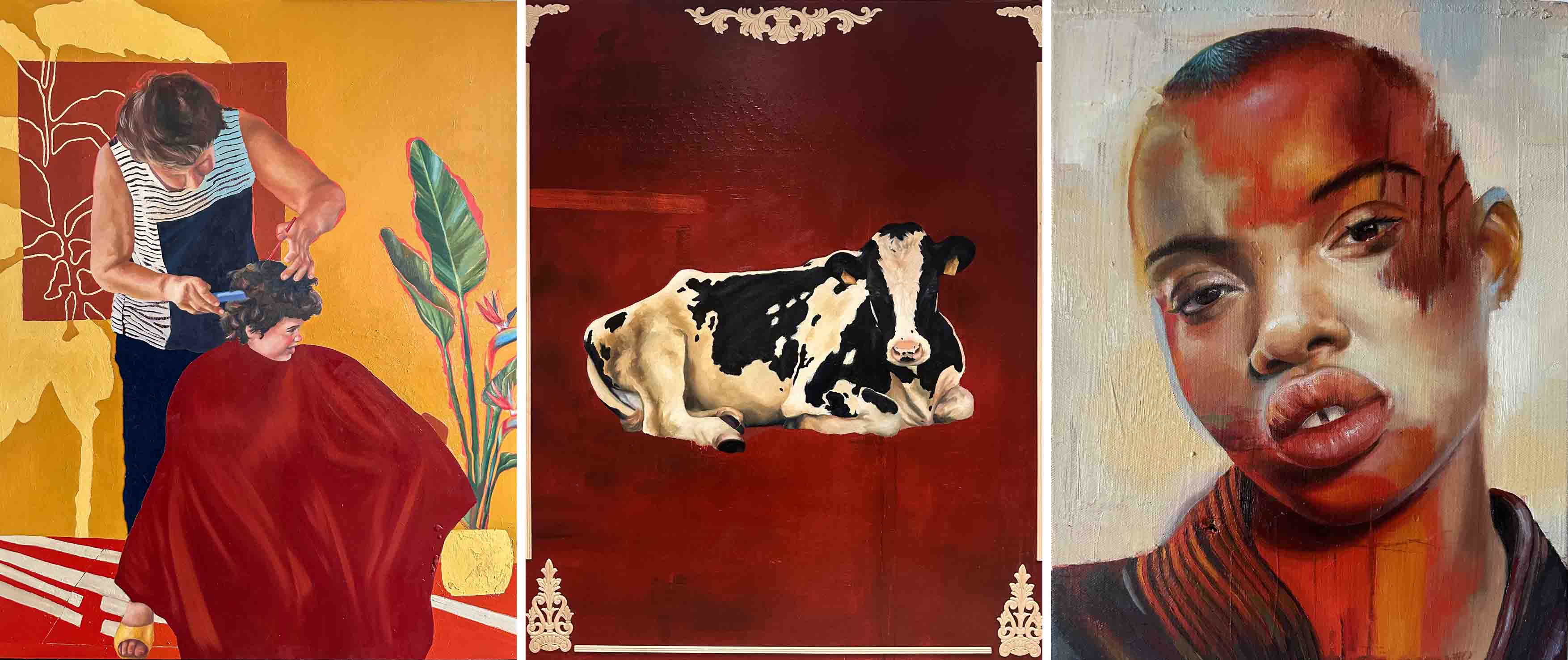
Honestly, I don’t really have a singular strategy. It changes depending on each piece I create, but it always starts with finding a photograph that evokes a memory or a feeling. I begin by paying attention to my sensory responses to these images, things like colour, texture, and the emotions they bring up for me. From there, I start translating those reactions onto canvas and building intuitively.
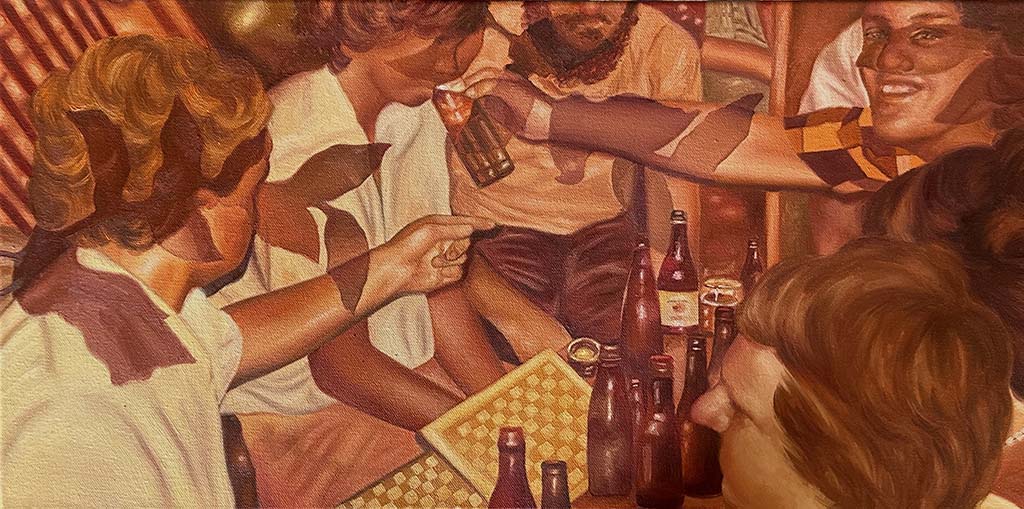
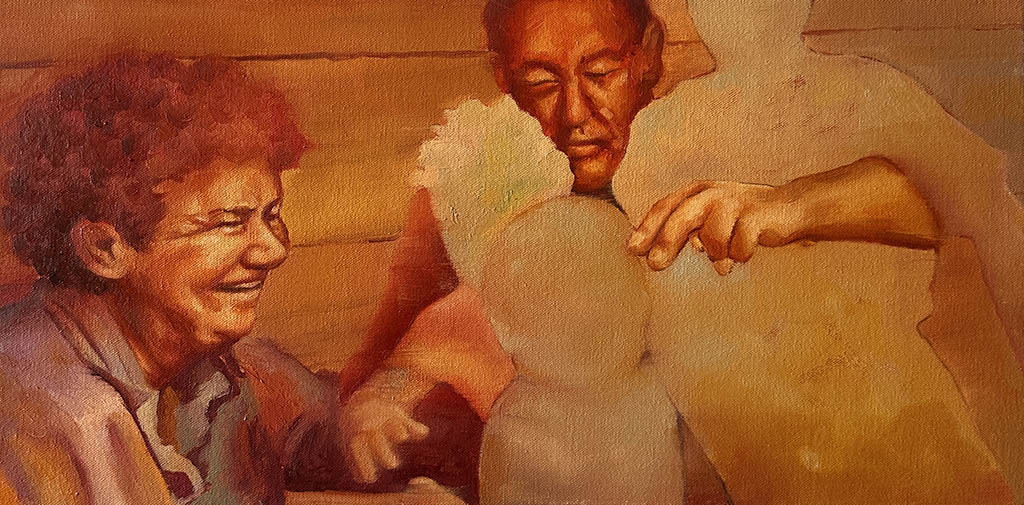
My intention is to let my unconscious fill in the gaps that time and cultural distance have created. In my work, absence, both familial and cultural, often appears through floral silhouettes or obscured forms. These shadows sit over family photographs and disrupt them.
This process happens organically as I paint and evolves throughout the creation of each piece. I know the work is complete when I feel I have captured that initial emotional response I had to the photograph.
Your work has been shown in both Canadian and international spaces, including galleries and museums. How has exhibiting abroad influenced your perspective as a Toronto-based artist?
Exhibiting in both Canadian and international spaces has made me more aware of how different environments interpret and understand my work.
Being based in Toronto, I sometimes think about my work within a very personal and local framework, but exhibiting internationally has shown me that ideas of diaspora, identity, and memory can translate in unexpected ways. It’s made me more conscious of how universal some of those emotional threads are, even when the cultural specifics differ. At the same time, it has encouraged me to stay grounded in my own lived experience rather than trying to make the work more “digestible” in a universal sense.
You’ve received several recognitions, including the Boynes Artist Award and the Museum of Dufferin Artist Award. How have these accolades impacted your confidence or opportunities?
I am incredibly grateful for the recognition I’ve received through those opportunities. More than anything, I’m grateful for the incredible people I’ve met along the way who made those opportunities possible. I think one of the most valuable resources for emerging artists is visibility. With social media and the competitive nature of the art world, it can be difficult to find spaces and communities where individuals can network and connect. Visibility has allowed me to meet people I never imagined I would, and I truly believe every artist deserves that kind of access.
I still very much feel like I’m at the beginning of my career and am continuing to navigate what it means to be an artist. So when these moments happen, there’s often a part of me that feels surprised, almost like, wow, they chose my work?
Because my practice is so personal, I sometimes find it difficult to fully sit with those achievements. I’m usually already thinking about the next body of work or the next direction I want to push my practice in. But these recognitions have definitely encouraged me and helped affirm that my art belongs somewhere.
Toronto’s underground and alternative art scenes are often described as vibrant but challenging. How has the city shaped your artistic voice?
Coming from a much smaller city in B.C., I often felt discouraged from expressing myself. I was consumed by the fear of being judged or being “too much.”
But arriving in Toronto changed that. I started spending a lot of time exploring every corner of the city and found a large part of my community here, which gave me the confidence to feel more comfortable in my own skin.
Toronto’s subcultures, especially its queer communities, have been incredibly important in shaping my sense of self. The city is undeniably vibrant, deeply creative, and expressive.
Seeing people embody such authentic versions of themselves really pushed me to create more honestly as well. At the same time, the art world in Toronto is highly competitive and can sometimes feel oversaturated. If there’s one piece of advice I’d give artists, it’s to keep entering different spaces, commercial, institutional, and independent. Don’t get discouraged. There is space for your work, your vision, and your voice.
Don’t be afraid to reach out to professionals, mentors, and other artists. That learning curve really helped me stand on my own as an artist. I stopped asking permission to be included and started finding the spaces that were already ready to include me.
How do you balance conceptual depth with aesthetic appeal in your pieces?
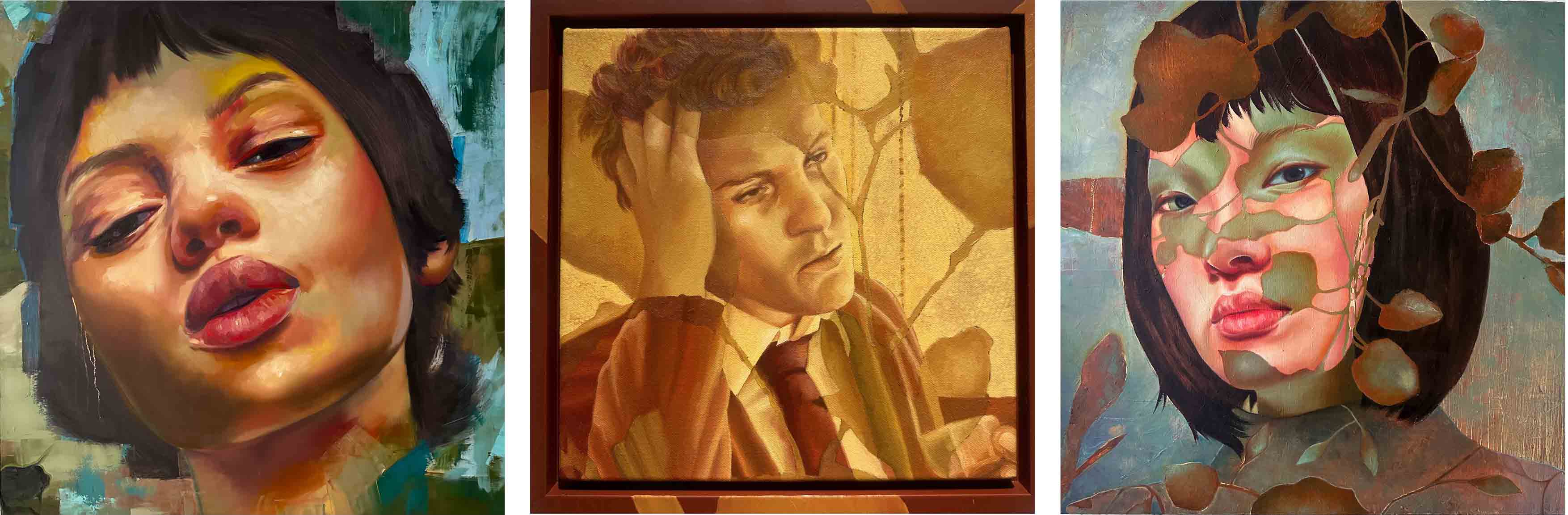
This was honestly something I had to work against and unlearn, especially because I work with realism, and realism is often associated with perfecting representation.
When I first started creating art more seriously, I was very focused on making “beautiful” work, what I thought of as “wall-worthy” work. That expectation I placed on myself became restrictive because I was afraid to get messy and make mistakes. But mess is how we experiment. It is creative knowledge, and that process is what brought me to where my work is today.
Although my work remains realistic, my process is no longer defined by how polished or aesthetically pleasing the final result is.
During my MFA, I spent a lot of time deprogramming myself from chasing purely aesthetic categories. I think there’s this illusion that good art is always aesthetic, but for me, good art is about raw expression. “Good art” can still be visually appealing, but its value shouldn’t be defined by beauty alone. I think my work is most successful when I’m not reaching for aesthetic perfection.
Now, I mainly focus on finding harmony and balance within the composition, allowing the concept to carry the story regardless of whether it appears conventionally pleasing or not.
Many of your works carry a strong emotional or atmospheric presence. What role does storytelling play in your practice?
Storytelling has become a very important part of my practice. A lot of my work is rooted in experiences of grief, displacement, and memory, and I express that through personal and familial stories involving culture, home, spirituality, and lineage.
I often work from family photographs, especially of people who have passed away or who are geographically distant from me, and I use painting as a way of holding onto those moments and relationships.
By translating these intimate images onto canvas, I explore how grief appears and how it lingers over time. More broadly, my work responds to ideas of state-imposed identity through acts of storytelling as personal documentation. Even though I am South African, I only hold Canadian citizenship, so painting becomes a way for me to create my own form of documentation, one that reflects my heritage, my experiences, and my connection to home.
What mediums do you find yourself most drawn to right now, and why?
I will always be obsessed with oil paint. That is my one true love. However, I’m increasingly bridging my work with archival and familial materials such as passports, stamps, postcards, and other objects that have been passed down to me.
I love being able to hold these materials in my hands and embed something personally meaningful directly within the canvas. I find these materials make the concepts and experiences I portray feel more tangible because the objects themselves carry emotional weight and history. They allow me to extend the language of painting beyond traditional frameworks and create a more direct relationship between my subject matter and the materials I use.
How do you approach experimentation in your work without losing a sense of cohesion in your overall portfolio?
Experimentation can be scary. Not a lot of artists talk about their experimental process because it’s often not the work that gets seen or completed. There’s also this stigma around artistic identity, the idea that your work needs to be cohesive or that you need a recognizable “brand” in order to be successful or sell your work. I completely disagree with that narrative.
As we grow, we change, and our creative influences change with us. I think artists should move through different experimental periods; it’s a natural and necessary part of development.
I don’t see myself ever becoming an artist who limits myself to one identifiable image or fixed style.
I approach experimentation by creating different bodies of work, and while they can vary significantly in material and form, they are always held together by the same emotional core and way of seeing. There is still so much I want to explore, sculpture, video, performance and none of that deserves to be tied down to a single identity.
For me, cohesion doesn’t come from repeating a style, but from staying true to my voice. When I create from what feels necessary in the moment, the work becomes a reflection of who I am, and that emotional consistency is what holds everything together.
What has been the most challenging moment in your artistic journey so far, and how did you navigate it?
Without a doubt, the most challenging part of my artistic journey has been maintaining confidence. As all artists know, rejection and failure are part of the process, but even with that understanding, it can still be difficult not to give in to doubt or question your direction. When I find myself in that headspace, I try to return to why I started making art in the first place.
It was never about approval or validation, it was always because I genuinely loved painting. So I’ll make a piece that is just for me, with no expectations attached to it.
I often end up painting over those works afterwards.
It’s kind of funny to me that many of my artworks actually contain multiple hidden paintings underneath them that will never be seen. But that process of allowing myself to create freely helps ground me again. It reminds me that my passion for my work is greater than someone else’s rejection of it.
What role do you think contemporary Canadian artists play in global conversations around climate, identity, and culture?
I think contemporary Canadian artists are uniquely positioned because of the diverse cultural contexts that exist within Canada, especially in cities like Toronto.Canadian art offers this intersection of Indigenous histories, immigration, and diasporic identities, which creates opportunities for artists to engage with ideas of climate, land, and belonging from multiple perspectives.
These personal stories become a way of understanding lived experiences and using individual narratives to reflect larger global conditions. For me personally, I see my work contributing to conversations around memory, ecology, migration, and identity.
Being a first-generation Canadian with parents who are both immigrants, my work reflects how cultural and familial dislocation impacts the way we access grief and community.
It is incredibly rewarding when the work resonates and opens space for discussion.
Art is a powerful tool for connection and reflection. It allows people to feel seen in ways that move beyond language barriers and even political and cultural boundaries. I think Canadian artists are increasingly contributing to global conversations in ways that feel both intimate and conceptually grounded by using personal narratives to reflect larger global conditions.
Finally, what advice would you give to emerging artists in Canada who are trying to find their voice in an increasingly competitive art landscape?
This might sound cliché, but the best advice I can give is to just keep making work, no matter what. Keep showing up for your practice, even when you feel uncertain. Keep pushing yourself to redefine your creative standards and continue producing art even when you feel discouraged.
Success, however you define it for yourself, doesn’t happen overnight, and it rarely follows a straight line. I think consistency is what truly builds a practice over time.As much as you make art, also make time to immerse yourself in the art world around you. Go to as many gallery openings as you can, meet other artists, and don’t be afraid to reach out to art spaces, residencies, and galleries. I’ve learned that a lot of this world is about building relationships and being present. Most importantly, carry your work with confidence and integrity.
Your message for us at TorontoPages magazine.
Thank you so incredibly much for this wonderful opportunity. It is such a pleasure and a joy to be part of TorontoPages Magazine and to share my work. I’m truly grateful for the support and for the chance to connect with more creative voices. Thank you for creating space for artists and for continuing to celebrate creative communities and storytelling.