A Contemporary Painter Reimagining History Through Texture, Memory, and Resilience
Toronto’s contemporary art scene thrives on voices that challenge convention while honouring history, and few artists embody that balance as compellingly as Keight MacLean. Known for her striking fusion of classical portraiture and experimental textures, MacLean creates deeply evocative works that bridge centuries, blending Old Masters influences with fluorescent pigments, metallic surfaces, engraving, and intentional marks of age and disruption. A graduate of OCAD University, her artistic journey has been shaped by a profound love of history, a transformative year studying in Florence, and an ongoing exploration of memory, identity, chronic illness, and the overlooked stories of women erased from historical narratives.
In this candid conversation with TorontoPages, MacLean reflects on her upbringing between rural Ontario and Toronto, the artists who continue to inspire her, the realities of building a creative career in Canada, and how beauty, imperfection, and resilience coexist within both art and life.
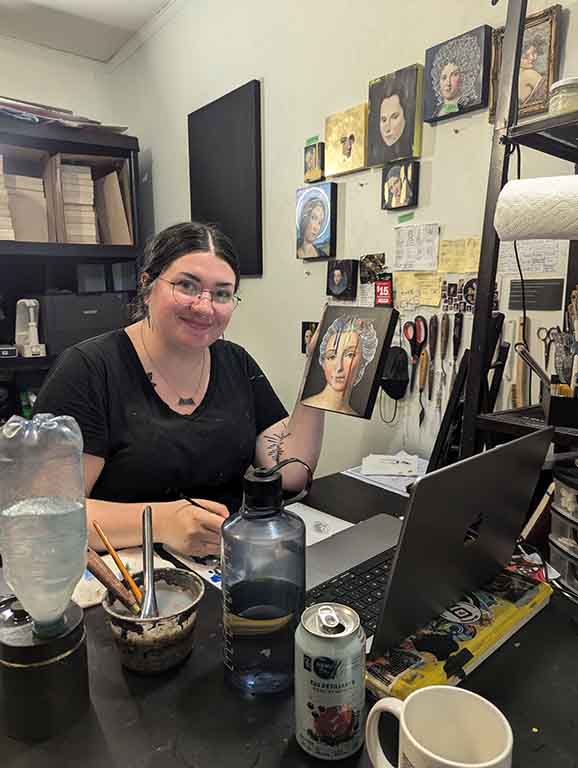
For readers discovering your work for the first time, how would you introduce Keight MacLean in your own words, beyond the artist bio?
I’m Keight MacLean, and I’m a giant history and art nerd who has been drawing and painting people my entire life! I’m a food and wine lover, a historical swordswoman, a potter, a camping enthusiast, a historical re-enactor, and an avid gamer.
You were born and raised in Kingston and later built your career in Toronto. How have those two cities shaped you personally and creatively?
I bounced around Kingston and the surrounding countryside growing up, as far out as Lyndhurst, Ontario. Kingston is a beautiful old town with a lot of history, and I’m sure that influenced me growing up.
My grandfather was very involved with the Fort Henry Guard, a historical re-enactment and exhibition drill organization at the Fort Henry historic site, and that love of history was definitely passed on to me, along with his love of painting.
Growing up rurally also really shaped me as a person. I spent a lot of time, time that other people my age spent hanging out together or wandering around malls, cooped up in my room making art and reading. While I might have been bored out of my mind at times, I think the countless hours I put into my craft really paid off in the long run.
That said, I spent a lot of those years yearning for the big city, and I moved to Toronto as soon as I could at 18 years old. I love being surrounded by arts and culture in a city that always has something new to show you just a couple of blocks away on any given day.
You studied at OCAD University with a major in Illustration and a minor in Drawing and Painting. How did that mix of disciplines prepare you for the artist you are today
I really believe that the mix of Illustration and Drawing and Painting set me up for success in the career I have today.
When I was a teen applying to art school, I had the perhaps ill-advised or outdated impression that illustration was a safer career path to justify taking out a bunch of student loans for, but I was never really much of an illustrator, and years of schooling didn’t change that very much.
However, the Illustration program at OCAD really shaped me as an artist in a lot of other ways. The deadlines were serious and gruelling, which instilled a strong work ethic around my art. The frank discussions about business and clients helped shape my mindset and gave me a solid understanding of contracts and copyright law for artists.
The program also included rigorous life drawing and traditional painting components that pushed me to keep improving technically. It really suited me.
My minor in Drawing and Painting actually came about because I messed up course selection one year and needed an extra credit. I ended up taking a wide variety of classes, ranging from foundational techniques to much more experimental work, and they helped round out my education while giving me the freedom to sharpen my skills in a much less directed way.
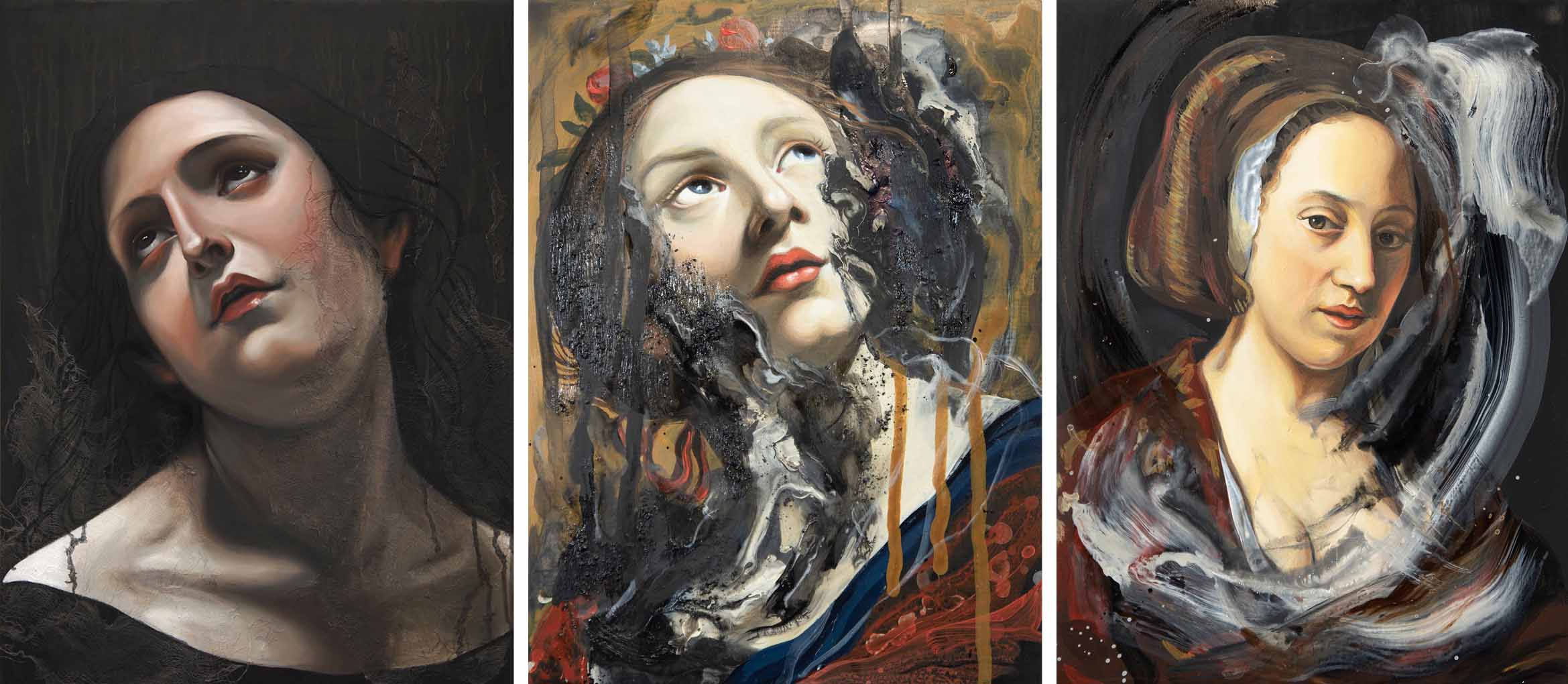
Your time in Florence through OCAD’s Florence Program seems pivotal. What was it like studying surrounded by centuries of art history, and how did that experience change your eye?
My year in Florence was definitely a critical moment for both my art and me as a person.
The program gave us a studio with 24-hour access, where we were expected to maintain an independent art practice with very little professor intervention. On top of that, once a week we had an art history class that more often than not took us to see the art we were discussing in person, both around Florence and occasionally on trips outside the city.
I thrived with that combination. I spent countless hours in the studio painting and pushing myself to get better every day, and in my free time I had a pass that got me into every museum and historical site in the city.
I lived a block away from the Uffizi and spent a lot of time there, which was beyond formative, but I also have to give credit to the smaller parts of everyday life that shaped me. There are churches on every corner filled with beautiful art you’ve never seen before.
Wandering through labyrinths of cobblestone streets and medieval buildings in a time before Google Maps and smartphones were as common as they are today was formative, as was eating beautiful Tuscan food, drinking wonderful Italian wine, and living a slower, more Italian lifestyle.
For the first time, I had a life centred around a studio practice where part of my daily work was finding inspiration, and it gave me a glimpse of what I wanted my future to look like.
You’ve said the Old Masters never really left you after Florence. Which painters or works still live in your imagination when you begin a new piece?
A dangerous question to ask me, I could go on for hours!
I became really obsessed with the Mannerist movement while living in Florence, and I still adore painters like Bronzino, Pontormo, and El Greco. Carlo Dolci is another quintessentially Florentine artist I’ve always loved and feel doesn’t get enough recognition, but he’s everywhere in Florence.
I’m also a huge nerd for Guido Reni and Peter Paul Rubens (or Pietro Paolo Rubino, as he was often credited in Italy). I love Caravaggio and the many Caravaggisti, but these days I’m drawing a lot of inspiration from female Old Masters.
Artemisia Gentileschi is always a favourite, but the lesser-known Elisabetta Sirani and Sofonisba Anguissola have been especially inspiring lately. I feel like their careers almost balance each other: Anguissola was a late Renaissance painter who studied under Michelangelo in her youth and painted well into her nineties, eventually passing wisdom on to Sir Anthony van Dyck and inspiring artists such as Caravaggio and Artemisia Gentileschi.
Sirani, on the other hand, took over her father’s studio and became the primary breadwinner of her family at just 16, painted somewhere between 200 and 300 works in her short life, and died at age 27, likely from complications related to a stress ulcer.
I think we all have a little of both artists inside us, and I let myself be equally inspired by both when beginning a painting.
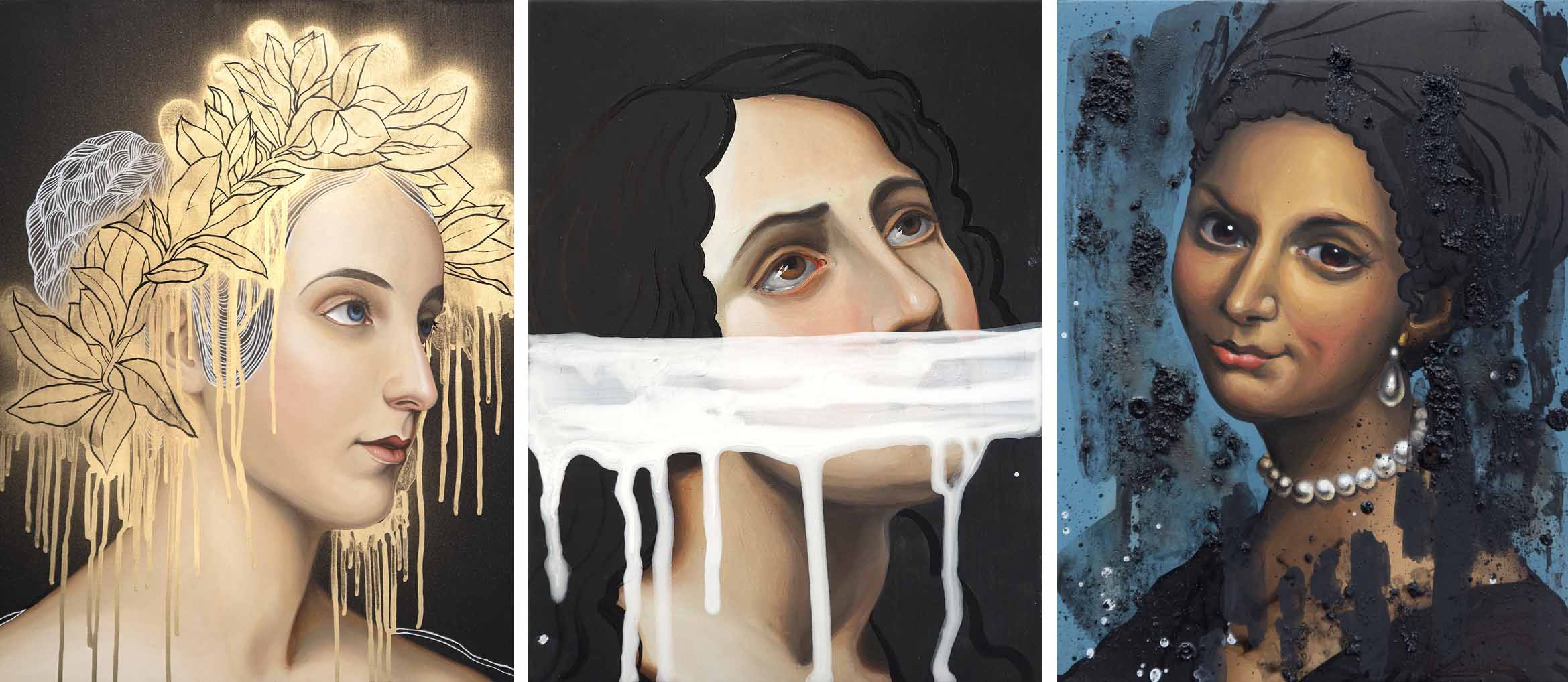
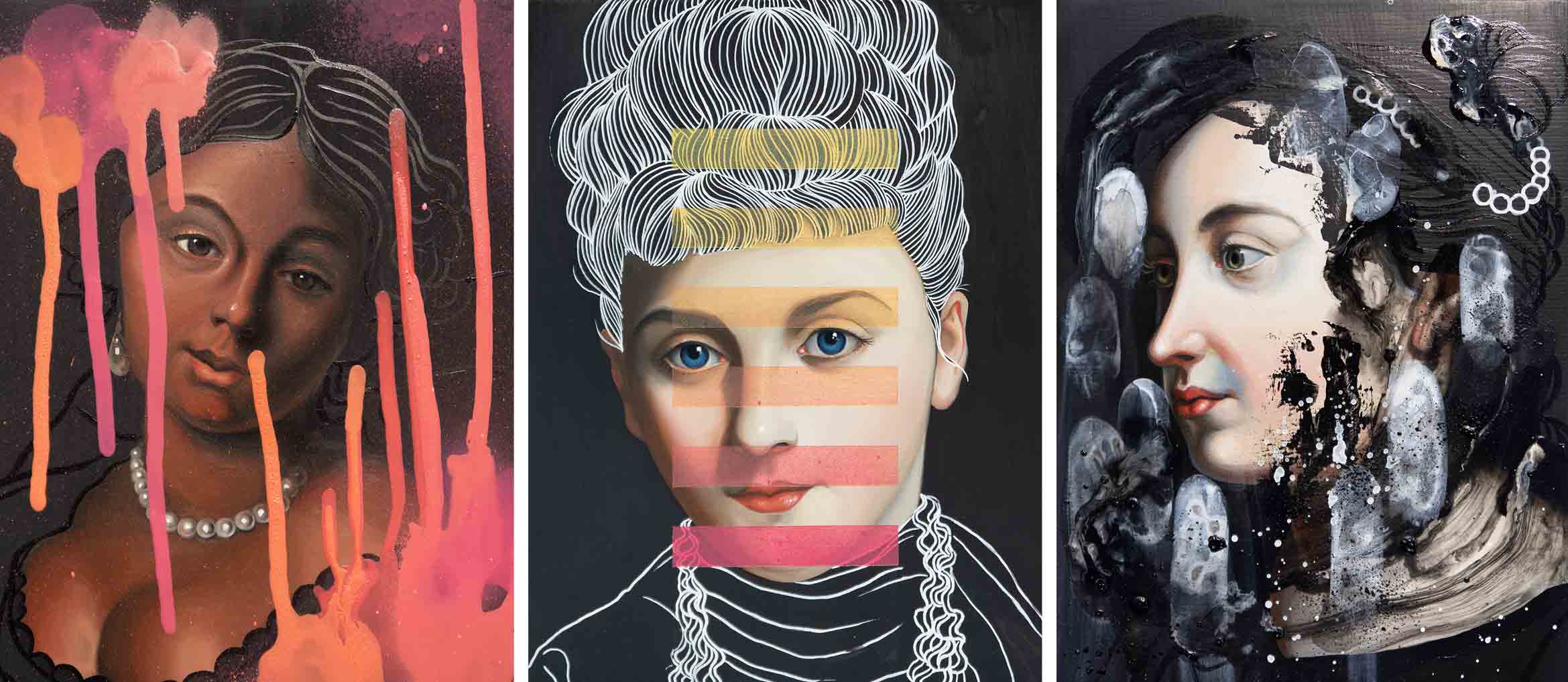
Your paintings often blend classical portraiture with fluorescent spray paint, metallics, cracking surfaces, and distressed textures. When did you realize tradition and experimentation could coexist in one canvas?
Early on, I was painting very traditional, restrained portraits and trying to bring an Old Masters sensibility into my work through composition and technique. Honestly? They were boring.
Not only that, but I never felt they were good enough, and they didn’t make me happy.
In my final year at OCAD, I was there for a whopping six years, I took a course on experimental painting practices. We had assignments that really pushed us, things like using six different methods of applying paint that weren’t brushes or painting on five different surfaces.
At the time, I was really focused on improving my technical painting skills, so I decided to create Old Masters copies for each technique and surface study so that I would end the course with a collection of small but complete paintings.
I had so much fun experimenting with materials and techniques, and over time that evolved into the body of work I create today.
Many artists protect perfection, while you sometimes intentionally disrupt or “damage” a beautiful surface. What does destruction allow you to say that perfection cannot?
I find so much beauty in damage.
One of the things I love most about studying history is the marks time leaves behind on an object or place, whether through organic ageing processes like oxidation and cracking or through human intervention, such as graffiti etched into church walls centuries ago.
A lot of my work chases that feeling of an object that has lived a life beyond its creation.
Bringing disruptive or chaotic elements into a piece can also feel cathartic after painting such meticulous and controlled portraits. In a way, working with dripping spray paint allows me to let go at the end of a painting and allow it to become something beyond my direct intention.
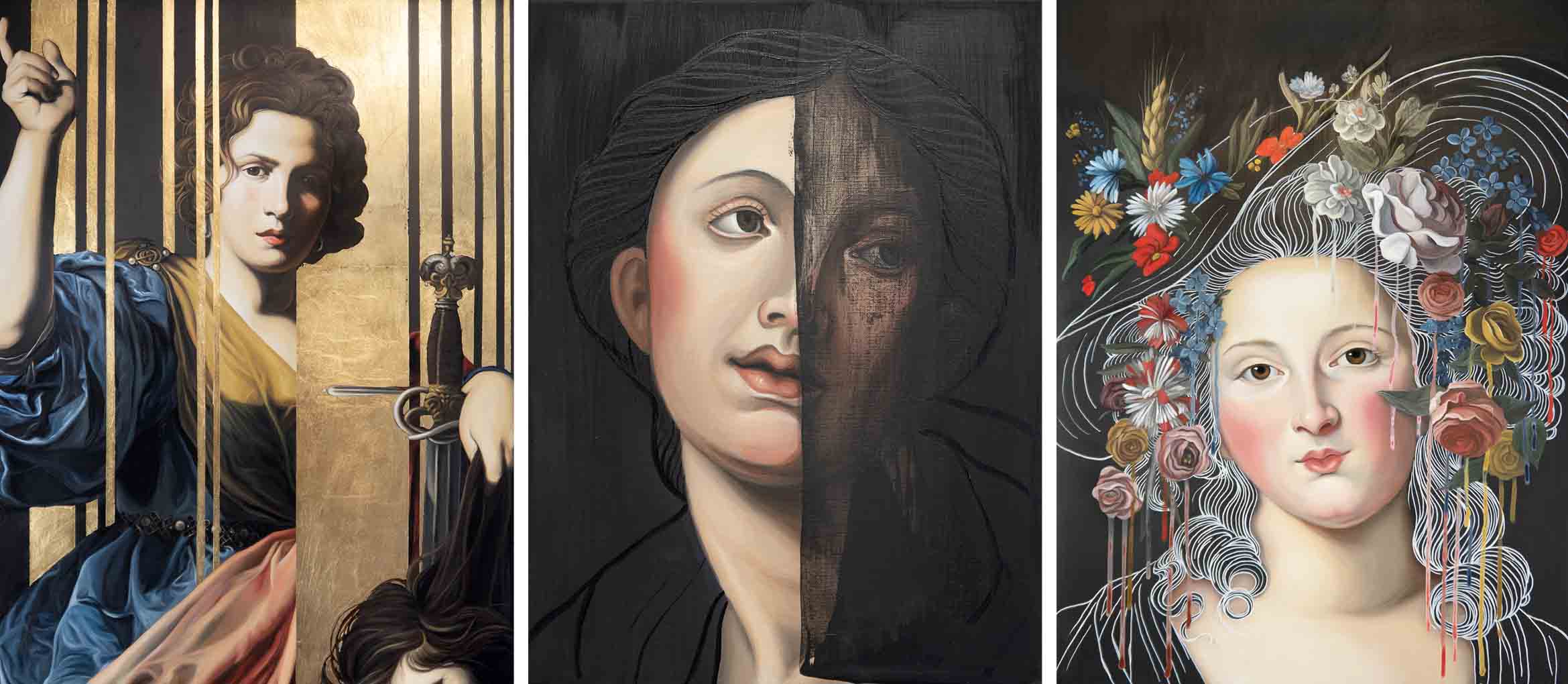
A recurring focus in your work is women who were forgotten, unnamed, or historically overshadowed. What first sparked your desire to reclaim those faces and stories?
I think I simply got tired of going to museums and hearing thousands of men’s stories while looking at portraits of women whose stories history didn’t see fit to record and often couldn’t even be bothered to remember by name.
That really struck a nerve with me. Since then, I’ve spent a lot of time seeking out women’s histories for my own education while paying homage to the stories we’ve lost or forgotten through my work
When you select a historical female subject, what are you looking for mystery, emotion, symbolism, or something more instinctive?
It depends on my mood.
Sometimes I become fascinated by the women who modelled or stood in for paintings of saints or mythological figures. Other times, I’m drawn to portraits of unnamed women and the mystery they carry.
And sometimes I’m moved by paintings labelled “the wife of so-and-so,” and I find myself reflecting on what it means to be remembered more for your relationship to a man than for your own story.
I bring a little of myself and whatever I’m feeling that day into every piece and ultimately make it my own.
Your work feels like a conversation between past and present. Do you see yourself more as a historian, storyteller, painter, or cultural disruptor?
I always see myself as a painter or artist first. I draw inspiration from all my interests in life, and history is just one of them. If my work inspires people to want to learn more about history, all the better.
You’ve spoken openly about living as a disabled queer female artist. How has that identity informed your voice, perspective, and resilience in the contemporary art world?
It took me a while to really understand and come to terms with how these parts of my identity have shaped my practice, and how important visibility and representation are within the industry.
I’ve spent a lot of time grappling with the importance of owning these experiences while also accepting the ways they influence my work and career, often in ways outside my control.
I think one of the most important things I’ve done for myself in recent years has been to begin making art about my own experiences and bringing more of myself into my work. I spent a lot of time during an artist residency thinking about how to bring my experience as a disabled woman into my paintings, and doing that work has opened entirely new avenues for creation and exploration in a way that feels deeply meaningful and vulnerable.
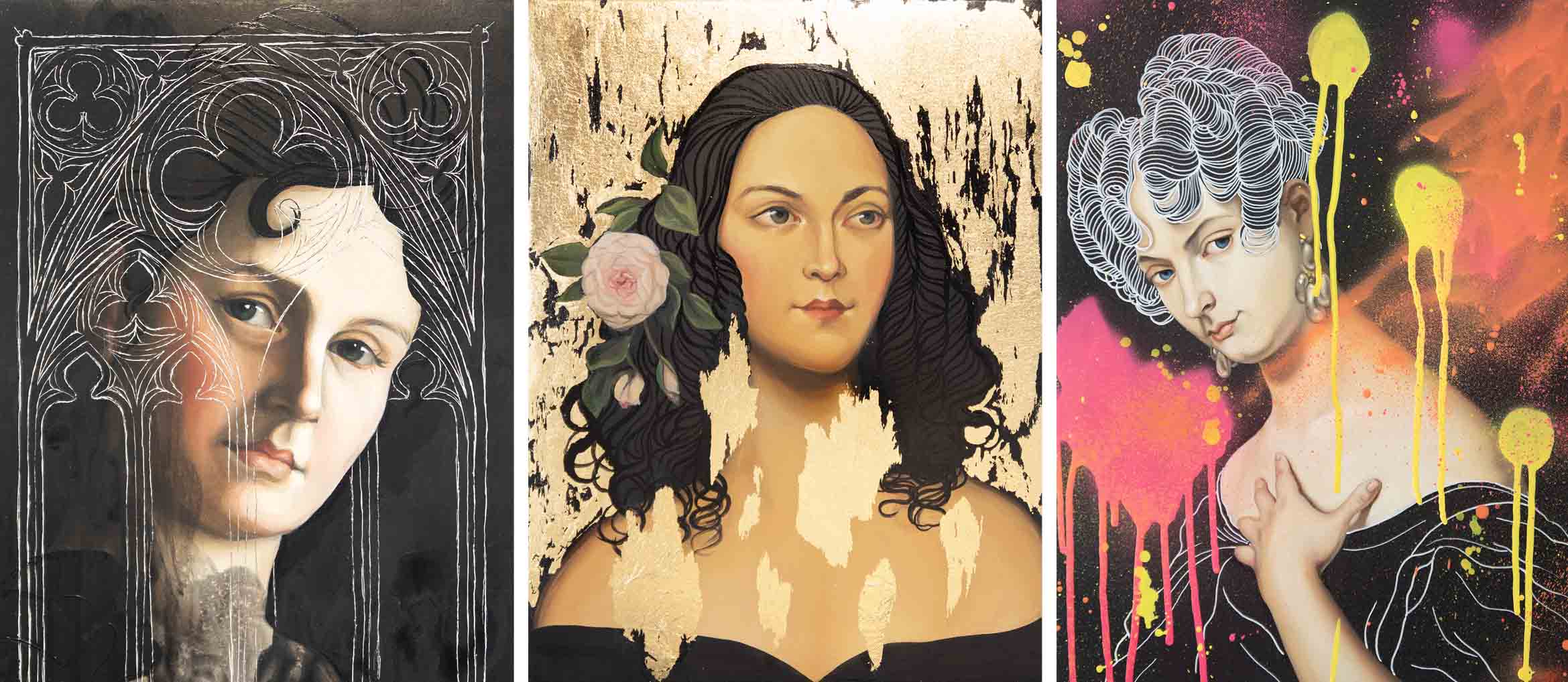
Your more recent practice explores chronic illness, deterioration, and the body through aged or weathered surfaces. How do personal health experiences become visual language for you?
The past few years have been a struggle health-wise, and finding a way to channel that experience into my work has been such a release.
I mentioned earlier that I find beauty in damage and the physical evidence of time, but I was struggling to find that same beauty in my own body as it felt like I was constantly battling against it. Finding a way to work through those feelings—and something positive to compare them to—became deeply healing.
I really began thinking more intentionally about how my health affected my work when I started incorporating more intricate engraving and carving into my paintings, which could be especially hard on the joints in my hands and, at times, painful enough that I had to stop working.
I found myself increasingly drawn to engraving anatomical illustrations, bones, and weathered architectural elements. The body affected by chronic illness and historical objects worn down by time have always felt linked to me in ways I’m still struggling to fully articulate.
There is often beauty and pain existing in the same frame in your work. Is that duality intentional, and does it mirror real life for you?
In my experience, beauty and pain often coexist
I think humans create beautiful things both as a balm to soothe pain and in reaction to it, whether through catharsis or because we find something unexpectedly beautiful within suffering itself
You work primarily in acrylics after developing sensitivities to oil materials. Did that challenge unexpectedly open new creative doors?
It absolutely did.
I had already been using acrylics for underpaintings for years before I was finally forced to make the switch, so I wasn’t starting from zero, but the learning curve was still significant.
I’m glad I spent years learning and painting in oils because that experience deeply influenced the way I eventually taught myself to paint with acrylics, which developed into a style of its own.
At the same time, acrylics opened up opportunities for experimentation that I never would have had with oils, and that has really shaped the work I create now. Also, I’m incredibly impatient and hate waiting for paint to dry, so I could never go back!
You’ve said you enjoy materials that don’t always photograph the same way they feel in person. In a digital era, how important is it to create art that must be experienced live?
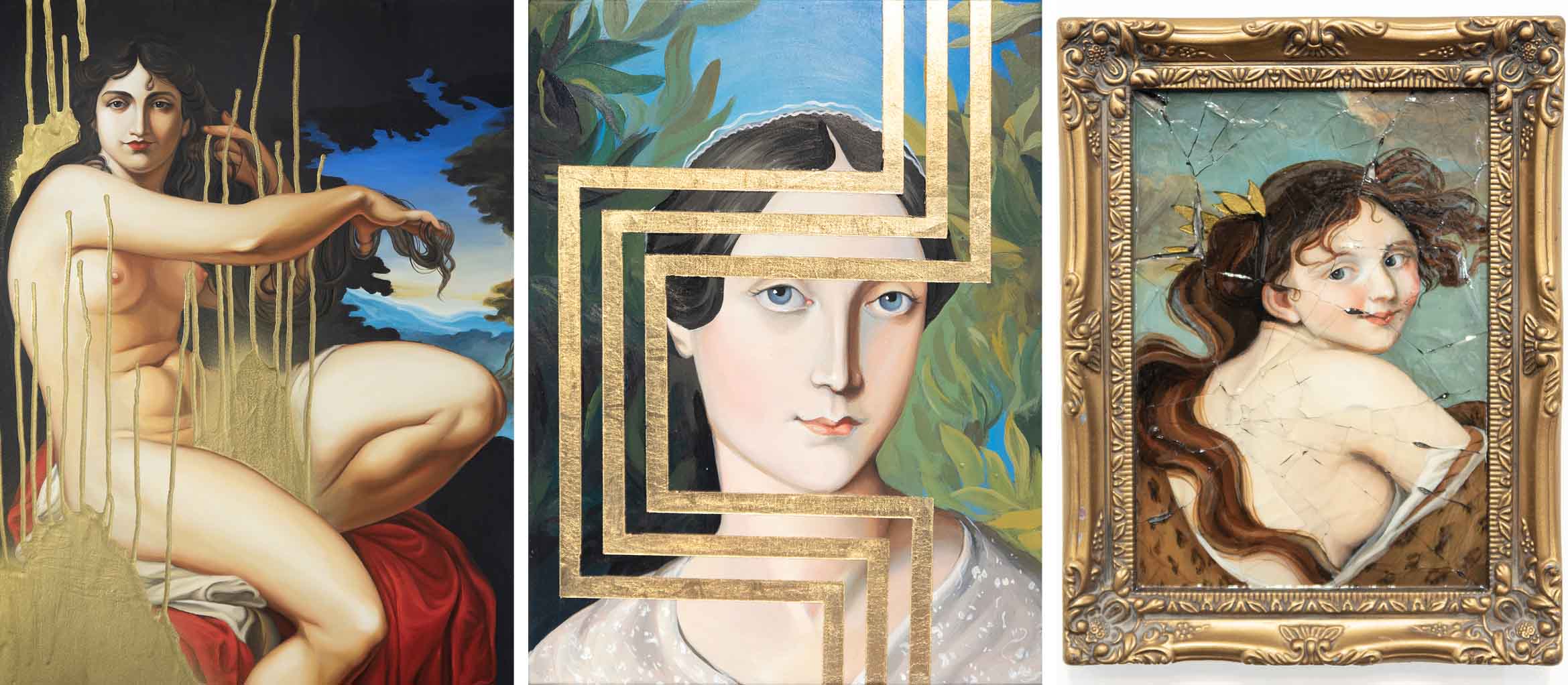
I’ve always been naturally drawn to materials like shiny gold leaf, fluorescent colours, and texture in paintings.
At first, it wasn’t intentional and was actually frustrating when trying to photograph work for social media, my website, or artist applications. But especially during the COVID lockdowns, I came to appreciate that the qualities that make art special in person are incredibly important in an era when so much of art and culture is experienced through screens.
There’s something magical about buying a painting, unboxing it in your home, and seeing gold leaf catch the light in a way that feels completely unique to your space, something no photograph can fully replicate.
You’ve had numerous solo exhibitions across Canada and beyond. Which show felt like a turning point where you knew this career was truly happening?
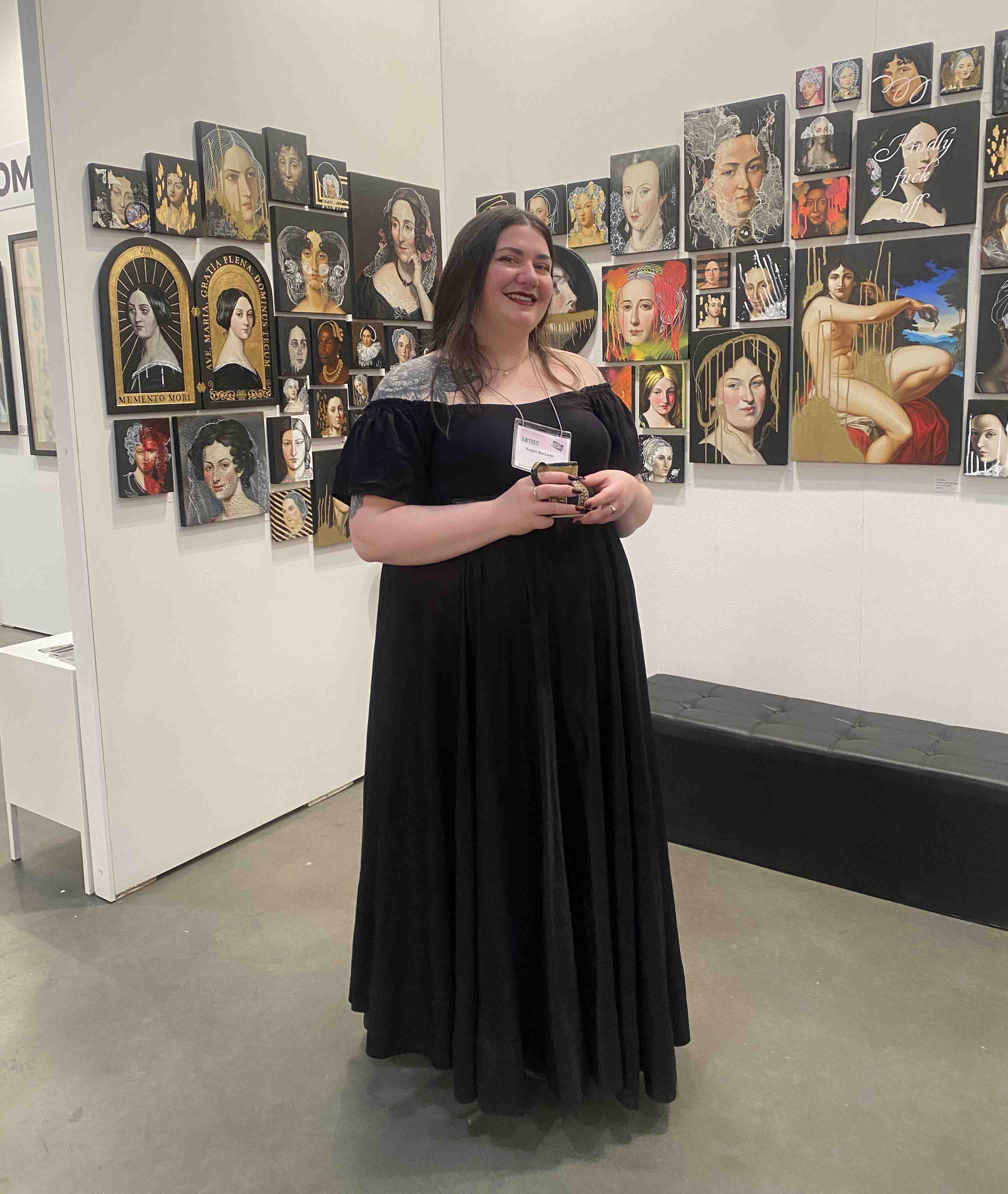
While my first solo exhibition at Studio22 felt like a dream, I think the moment I realized I could genuinely make a career of this came earlier, during my first art fair.
I had just graduated from OCAD and was accepted into the Toronto Outdoor Art Fair (formerly the Toronto Outdoor Art Exhibition) for the first time. I showed a mix of school work and personal work, met so many people who still follow my career today, and sold so much work that I actually had to bring additional paintings from home to fill the booth on the final day.
I ended up selling my entire thesis collection of ten paintings to a single collector, and that was the moment I realized this could truly become my career, if I kept working at it.
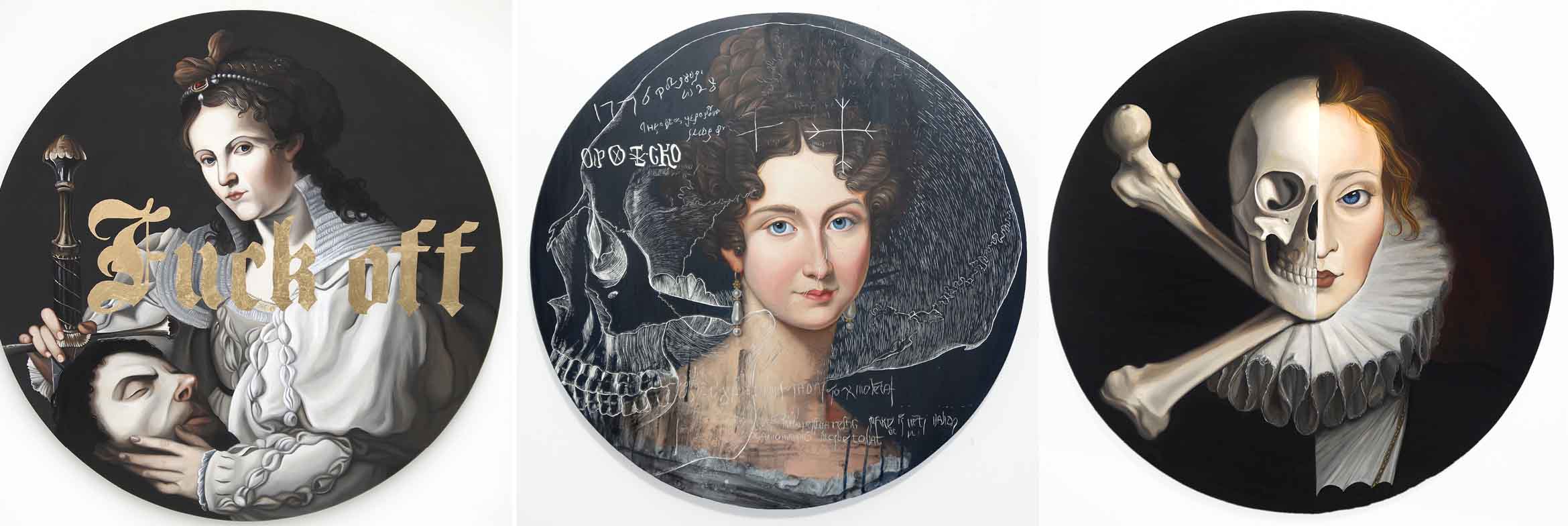
Your museum exhibition Ordinary Women sounds especially meaningful. What did that title represent to you?
Maybe it’s because my fascination with history often revolves around everyday minutiae, but I always like to imagine the lives of the women I’m painting and remember that, despite having portraits that survived history, they were simply ordinary women like me.
They woke up each morning, ate meals, went about their daily routines, and went to sleep at night.
There’s something deeply interesting to me about imagining yourself living their lives and finding little historical details that remind us people have always been people. Across centuries, we often have much more in common with them than we realize.
You were awarded Best of Painting at the Toronto Outdoor Art Fair. What did that recognition mean during such an unusual time for artists
The summer of 2020 was a wild time to do much of anything, let alone receive recognition through what was probably the biggest award of my career.
It felt meaningful to still come together for an event I had participated in for four years and had become such a consistent part of my life, even if it had shifted online during such a turbulent moment.
A lot changed for me that year, and the lockdown unexpectedly gave me time to better understand how to sell my work online, which ultimately became a huge benefit.
Receiving that kind of external validation felt especially meaningful during such an isolated and uncertain time.
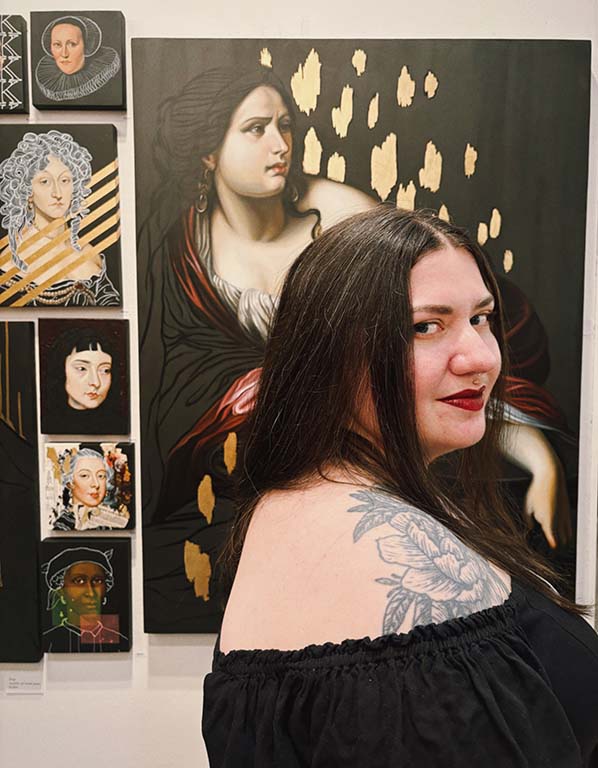
You’ve also participated in residencies, including Château Orquevaux in France. What does stepping away into a residency environment give you that daily studio life cannot?
Keeping up in the art world is really a full-time job, and it’s easy to get caught in an endless cycle of creating, posting work online, applying for opportunities, producing work for deadlines, and repeating the process.
Residencies are valuable because they completely remove you from routine, both artistically and personally, and force you to become much more intentional about what you’re making and why.
You start thinking more deeply about your work and often find inspiration everywhere when you’re removed from familiar surroundings and placed in a beautiful new environment.
At a residency where meals and day-to-day responsibilities are taken care of, it becomes much easier to spend 12 hours a day creating, seven days a week, while feeling invigorated rather than exhausted.
It’s an incredibly valuable experience for me, and I’m always looking out for new opportunities.
Your message for us at TorontoPages magazine.Thank you so much for taking the time to chat!
I hope people will visit my website at KeightMacLean.com and follow me on Instagram @KeightMacLean. If you’re free this summer, come visit me and more than 300 artists at the Toronto Outdoor Art Fair at Nathan Phillips Square. I’d love to see you there!